Knowing what trail surfaces you might encounter can make a difference in whether you feel you can visit an area or not.A handicapped accessibility designation can be helpful, but can also be misleading. This location had tree roots that made wheelchair access limited. Knowing such details can make the difference in each person’s decision whether to visit a specific area or not
This article was first published at the Travel Massivewebsite. Many thanks to their editors for providing a platform for travel interests of all kinds, around the world.
Knowing about bridges with railings is a big plus for those with balance issues. “Know before you go” is so helpful
Lots of trail guides and magazine articles provide information about the compelling reasons to visit any certain area. What is consistently missing is information about trail surfaces. Whether you have a disability or simply enjoy the outdoors you can be make a difference to others by noticing and then sharing with others details that are included in the article below.
My Story of Hiking with Mobility Challenges
Mobility challenges do not keep people home. Lack of information and/or support makes getting outside more difficult
Travel Massive article:
Some people think that because I have written a number of trail guides I must be a super hiker. In fact, there was a time in my life when walking across a room was an insurmountable challenge. While healing has come after disastrous brain surgery that saved my life yet left my right side paralyzed, I still require support to navigate uneven surfaces: bumpy sidewalks, crowded airport terminals, or rooty or rocky outdoor spaces.
One of the most important factors that dictate whether I can safely manage an outing is asking about an area ahead of time. To safely navigate an outdoor trail, I need to know about trail surfaces Easy Walks, that is, not too many roots or rocks, relatively level, with something of interest along the way.
We have spent the past several weeks exploring the SNETT (Southern New England Trunkline Trail) that runs quite near our home. Improvements have just been completed from Center Street in Bellingham, MA west to Rt. 126, near the Blackstone, MA line. What has up to now been one of the more challenging sections of the SNETT, this portion of the trail has limited views, but is key to opening up further sections of the SNETT west of here. Park at the Center Street parking area. Once parked, head west. An additional, Harpin Street entrance is next to DiPietro Elementary School, with parking across the street at the athletic fields. This area was until recently a barrier for those wanting to access other western sections of the trail.
We started in the southwest of Newfoundland near the ferry landing in Port aux Basques, and after a week moved about two hours north along the Trans Canada highway to the Port au Port area.
Easy Walk to fossil treesFossil tree (black) in stream
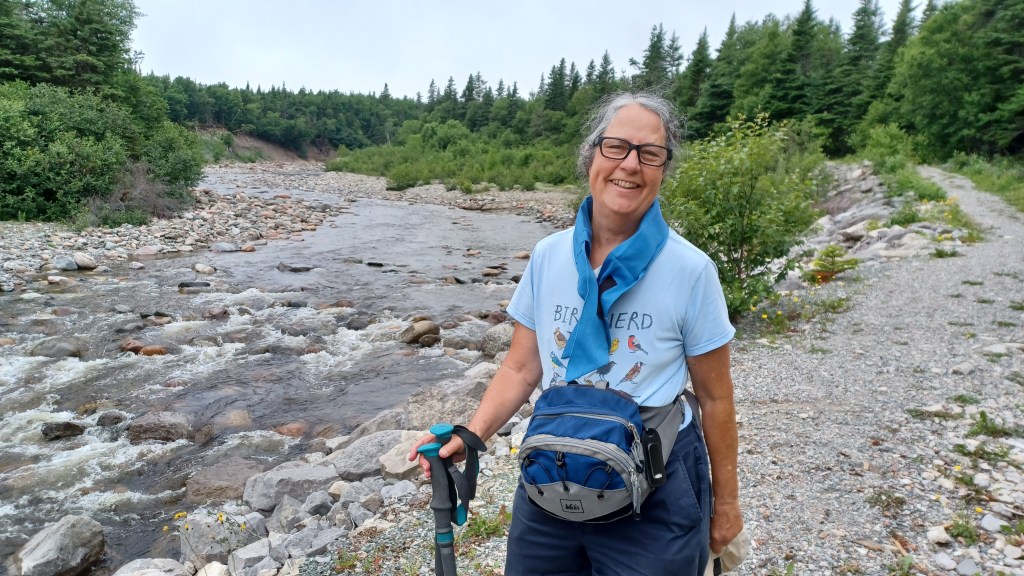
On our way to our next campground we visited the Blanche Brook fossil beds in Stephenville, Newfoundland. The packed dirt path in the sunshine along the brook near a parking area offered solid footing for me. Once we entered the woods the trail continued alongside the water, and for the most part was still an Easy Walk. However, to actually see the fossils, visitors need to get down the banks of the stream and wade into the water.
We had just had some heavy rains, filling the brook and making for very tricky footing. I stayed on shore while my husband rock-hopped out to the small island in the brook where he took his shoes off and waded in for a closer look. He got some great views of the fossils, preserved trees turned to rock. We were the only visitors when we stopped on a July morning. Like many other places while in Newfoundland, we often found these outdoor sites to be surprisingly uncrowded.
Doing my part…
A private campground was our home base for several days while we explored several areas that offered some great Easy Walks. After leaving the fossil beds we moved on to a private campground in Stephenville, our home base for several days while we explored several areas that offered some great Easy Walks. Power and water hookups at provincial campgrounds are limited. Since we needed some power to recharge our camper batteries, rather than stay at another provincial park, we chose to stay a night or two at a campground that had “hookups.”
Both national and provincial parks are great places to visit in Newfoundland. Besides these government sponsored outdoor spaces, we were surprised to discover stunning outdoor places that local communities oversee. Even more surprising is that a number of them that offer Easy Walks in areas that are otherwise very difficult to access. Once we were settled in the campground we headed back out to explore nearby Sheaves Cove.
Hidden fallsView of the marsh from path to the falls
Sheaves Cove offers not just one, but two Easy Walks. The creating an maintaining of these trails has been a labor of love, and I really appreciated the care that went into making these trails accessible for many of us. The first trail we explored took us down to the Hidden Waterfall. Quite obvious once you have driven down the dirt road leading to the parking, this waterfall is not visible from the road unless you know where to look.
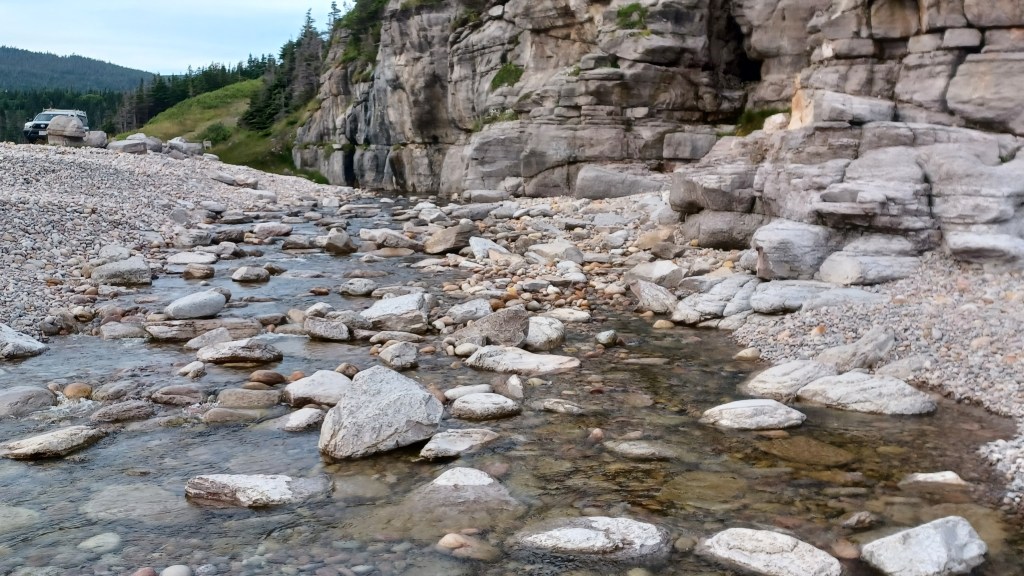
Stream near the parking area flows from the waterfall through the marsh into the sea
The water from the falls flows out through a marsh and empties into the sea right next to where we parked. The path down to the falls is a maintenance access type road, quite broad, packed gravel, with a gentle incline that takes you to the bottom of the falls.
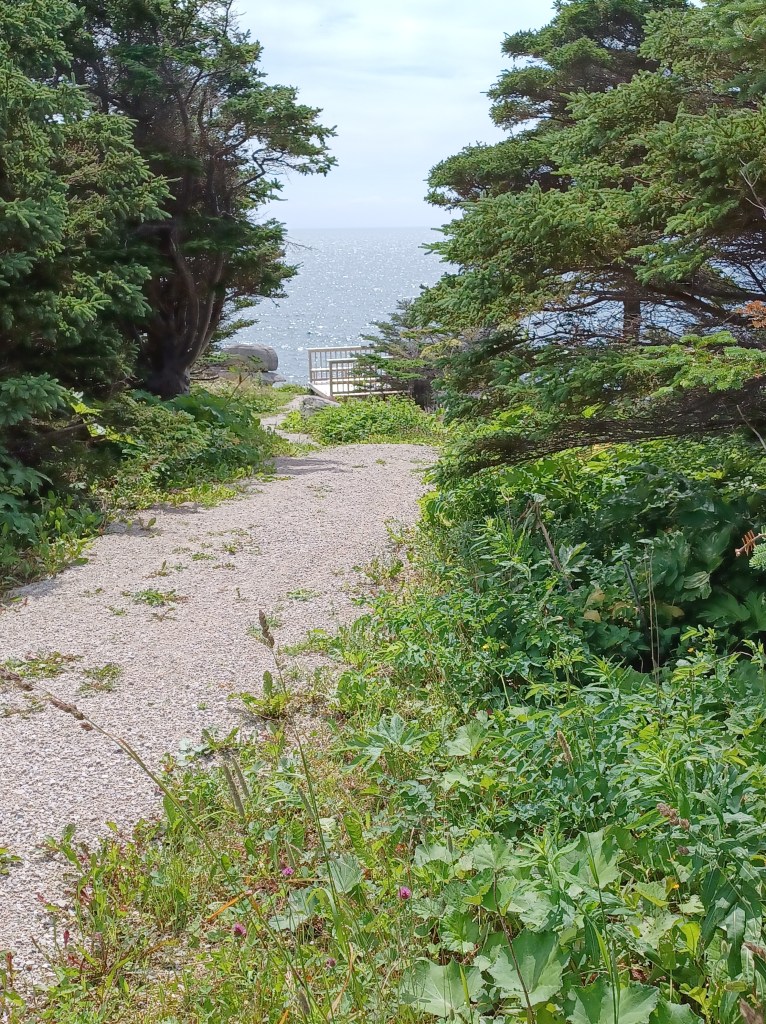
Gravel paths lead to coastal viewing platformsCapstan, used to pull boats ashore
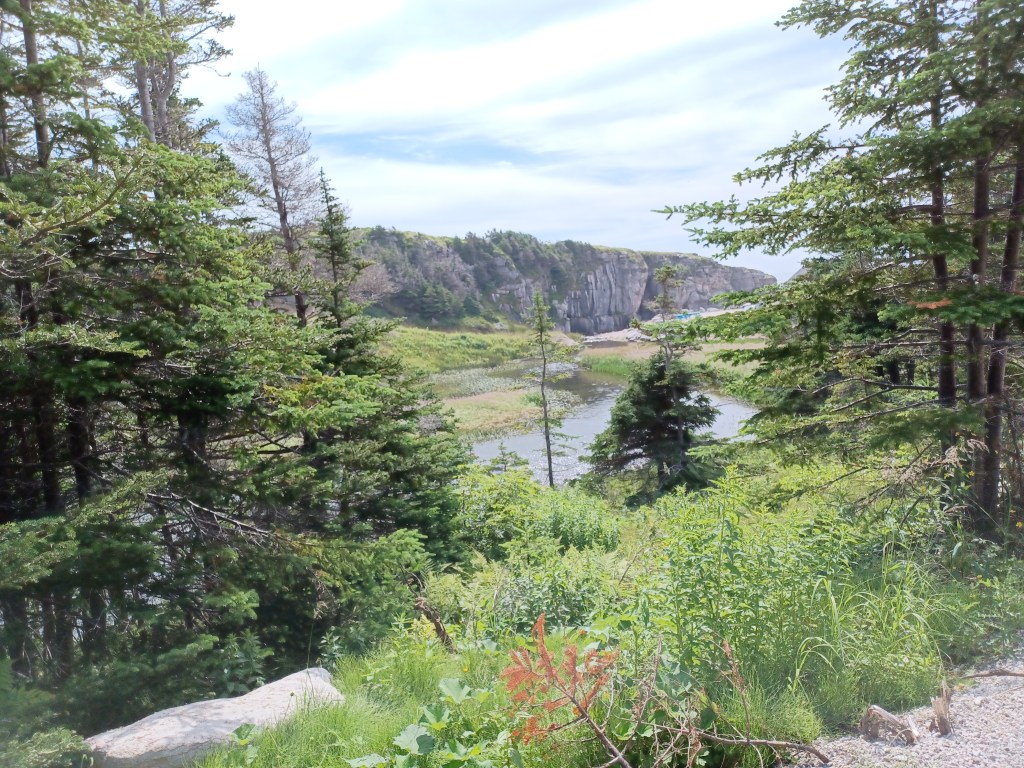
On the opposite side of the parking lot is a trail that invites visitors to stroll along the cliffs overlooking the ocean. This path is quite wide, packed gravel and offers amazing views of limestone formations right along the shoreline.
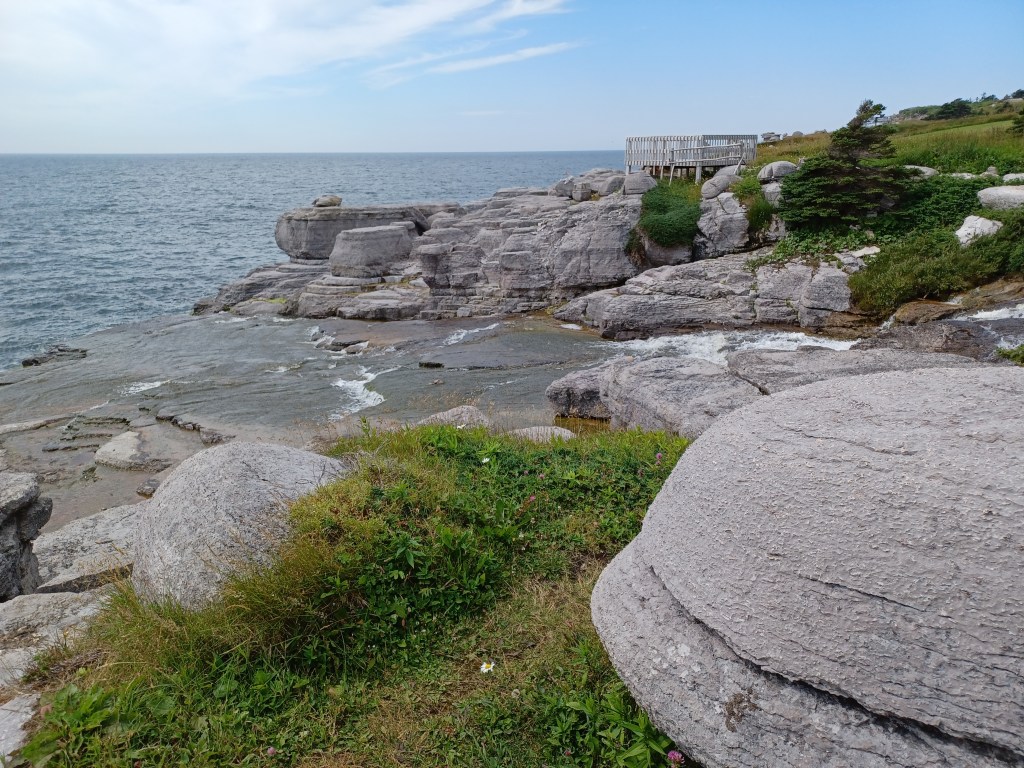
Limestone mushroom along the cliff
Viewing platforms long the way present opportunities to get even better views of the area than you can see by walking along the top of the cliffs. Some limestone formations reminded me of mushrooms, though certainly not very tasty.
Water cascades down the limestone cliff into the sea
Yet another waterfall in this spot tumbles down the cliff, crossing the trail, cascading directly into the sea from the rocks just above the waterline. A bridge allows visitors easy access to the other side of the water. We spent hours taking in the views, resting at the viewing platforms and looking for whales. No luck with whales on this outing, but we spotted them on other visits during our trip.
Humor on the trail
We found more Easy Walks in the Port au Port area that I will leave for our next post. On our next outing, we encountered a provincial park that offers more Easy Walks, and clearly has a great sense of humor. Till then, happy trails!
Many years ago our family headed to Cape Breton for a driving tour. I decided that puffins would be the best part of our travels. A place in Rockland Maine offered a way we could see puffins. A minor (four hour round trip) detour, some of us were more excited about than others. When we arrived in Rockland we learned that the puffins were quite a distance off shore, but we could watch by video what the puffins were up to. (We could have watched from home, I suspected.) Clearly I had not done enough reading before insisting we take this side trip.
We visited Newfoundland in September of 2018 when it would have been too late to see puffins. They are pelagic and thus are visible from land only when they are nesting–April to August. On our most recent, 2022 trip, we first thought we’d missed the puffins, but soon learned we were not too late! Our 2022 trip to Newfoundland began in the southwest corner of the island, after a ferry ride from Sydney, on Cape Breton, Nova Scotia, to Port aux Basques, Newfoundland. Puffins nest on the eastern coast. It was a long ride from one point to the other.
Beaches get so crowded in summer that it is tough to find a quiet spot to take in the water, the horizon, and the sounds and smells of the ocean. We normally avoid going to the beach in warmer weather for these, and other reasons.
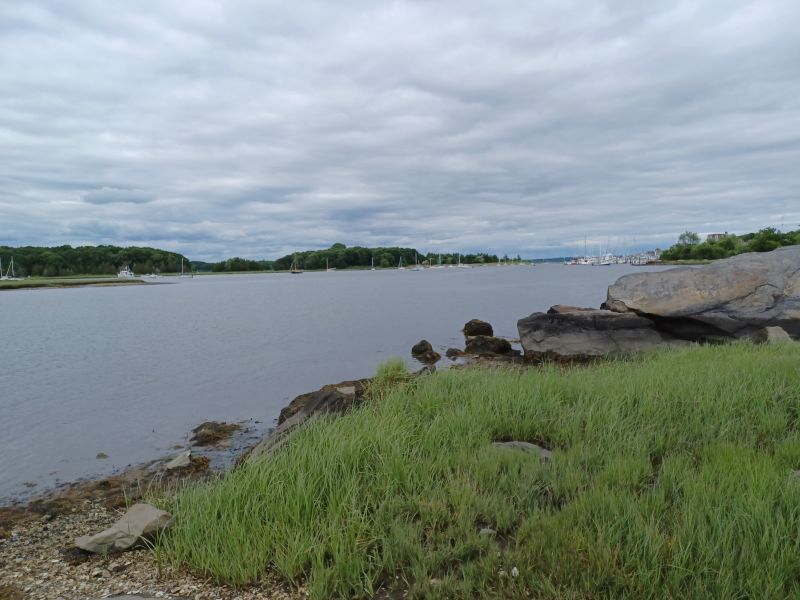
We ventured to Wickford, RI on an errand, and on our way back north encountered Wilson Park, on Roosevelt Ave., North Kingstown, RI just off Rt. 1A. The main portion of the park was jammed with summer visitors. Children climbed on playground equipment, while others picnicked, played basketball, baseball, soccer, or simply lay out in the sun. We hurried past the noisy main park and found ourselves at the Long Point boat ramp, part of Wilson Park. As opposed to most places with shoreline access, this area was surprisingly uncrowded.
Lots of us grew up watching Saturday morning cartoons. But not so many get to really hug Yogi Bear. A series of cimcumstances brought us to Jellystone Park near Natural Bridge, Virginia. We feared the place would be filled with noisy campers, but instead, we arrived early in the season and had the place to ourselves.
Advice is often handed out like candy–“Just let go, and have a nice day.” Why some think it’s simple is beyond me. Letting go has never been that easy in my own life, for sure! One day I finally began to grasp what was wrong with this advice, or at least, what was missing. Here’s the story: (an excerpt fromMy Liturgy of Easy Walks: Finding the Sacred in Everyday (and some very strange) Places.
Well-intentioned people offer varied strategies intended to short-circuit the difficult process of “letting go,” whether it be of worries, pain, hurt, relationships, the past in general, or even prolonged grieving. The list of life challenges is endless, and suggestions for how to cope are endless too, yet have been useless in my own experience. I have learned that letting go is something that happens on its own time schedule, not because of trying harder.
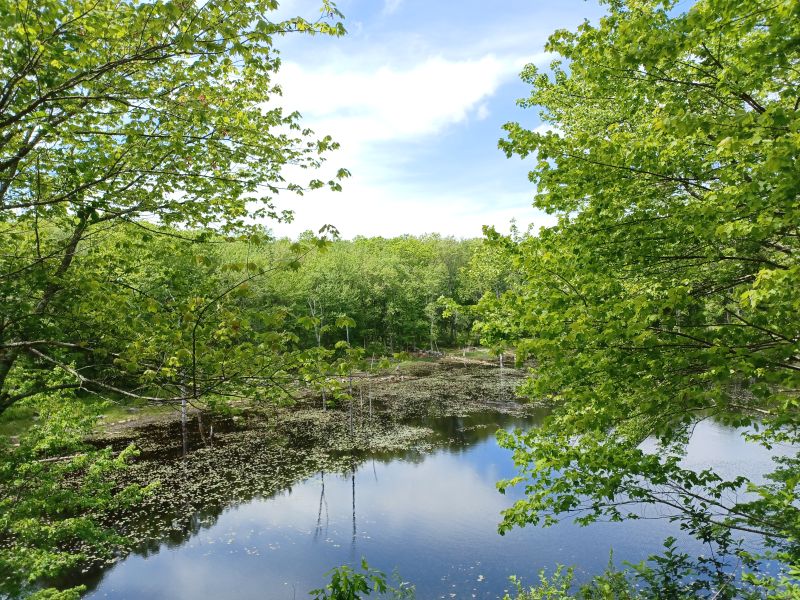
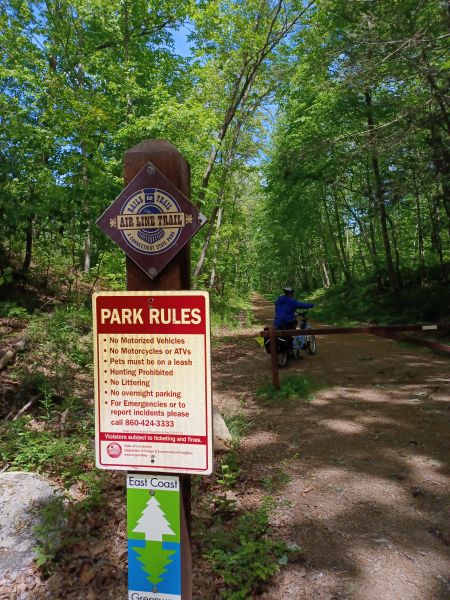
Along the Airline Trail near Hampton, Connecticut. Difficult to see here, but this pond must have been flooded by beavers. Stone walls from the shoreline lead all the way down past the water’s edge
In our travels with our camper, we have found state forests to be a great resource, often providing camp grounds where we had great experiences. Many have trail networks, one state forest we stayed at had a handicapped accessible overlook, and others were simply great spots to stop and enjoy the scenery.
One access point along the Airline Trail
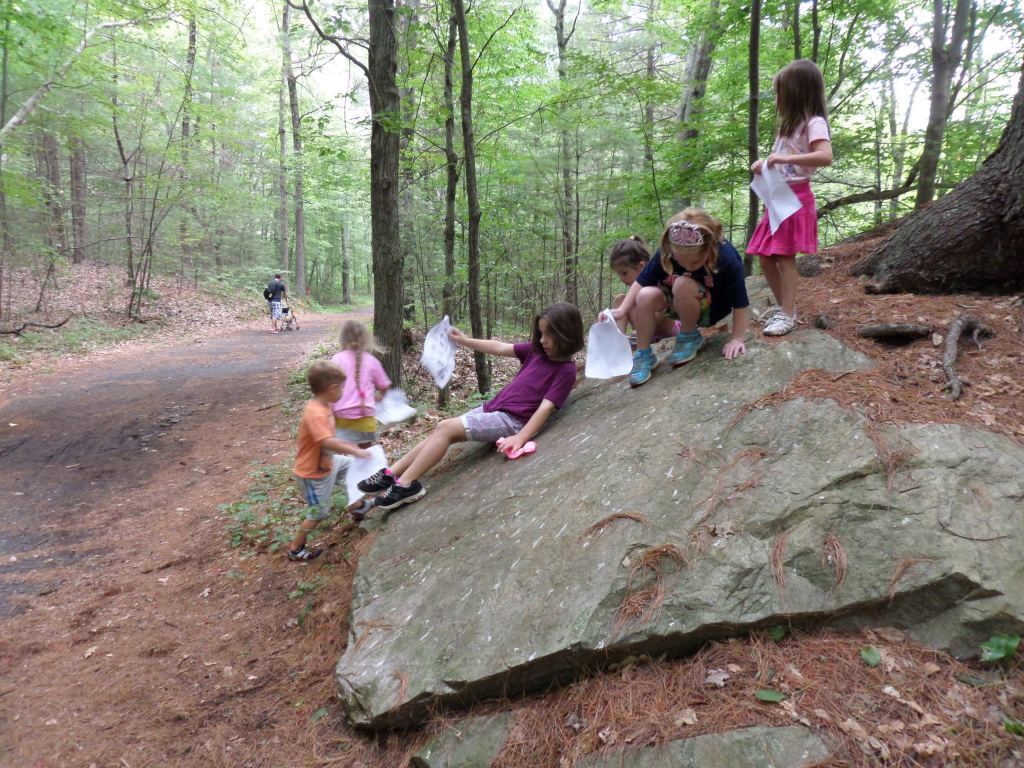
On our way to a rail trail in Connecticut, we stopped by a state forest we spotted along the way and discovered a gem (and access to yet another portion of the same rail trail we had been headed toward). The James L. Goodwin State Forest in Hampton, CT offers multiple options for enjoying the outdoors. The boat ramp allows small craft to enjoy the pond. The Conservation Center, located inside the State Forest, offers education programs. When we looked at Google maps we realized that the Airline Trail passes directly through this same state forest.
Blue skies in winter can be deceptively cold. A clear, calm day with no wind is a joy, while a stiff wind can be a real challenge for any outing in these darker months. Our visit to Chase Farm in Lincoln Rhode Island offered a mix of weather. Windy on the wide open fields of this historic town-owned property, and Easy Walking in the sheltered spots tucked here and there along the service roads and mown paths that cut through the fields of this former pasture land.
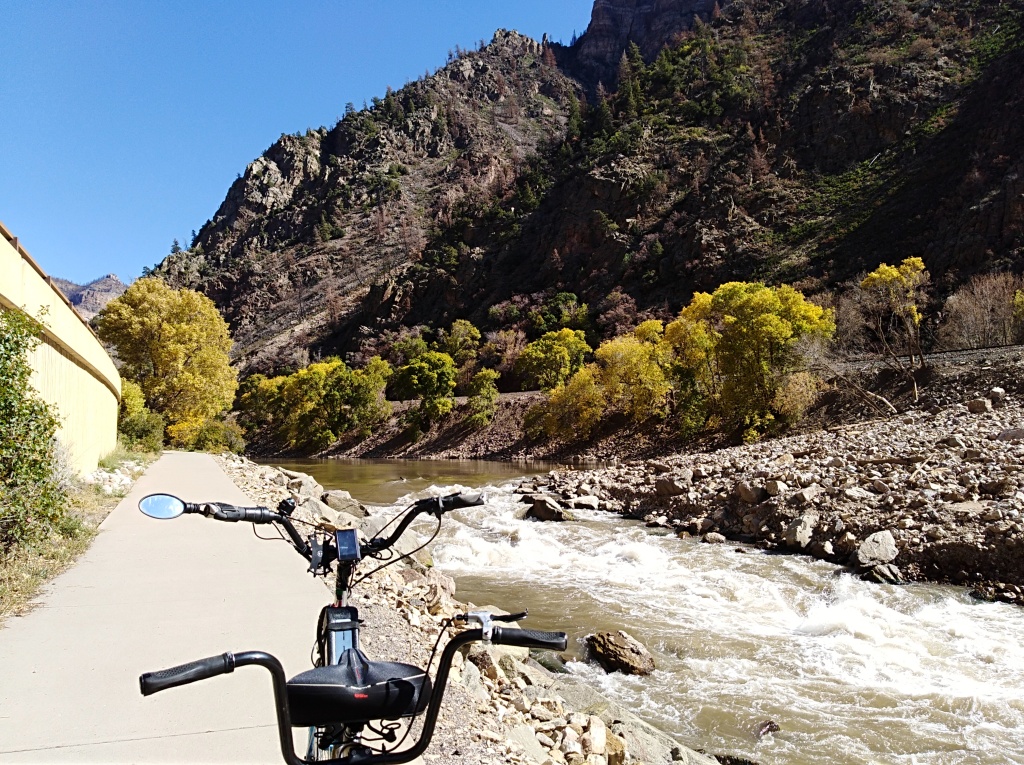
In our western travels, a secondary goal to our spending time in Glenwood Canyon on the bike trail that wends its way through the canyon was to explore Carlsbad Caverns while we were in the west. For many reasons, including keeping crowds down through the pandemic, a visit to this National Park for the self-guided tour through the cavern requires reservations. Thus, our relaxed itenerary for this trip suddenly became a push to meet deadlines, dates, and specific times reserved to reach Carlsbad, New Mexico. This not only required excessive amounts of driving, It meant places we would have otherwise enjoyed stopping to explore were mostly by passed because we were pressed for time.