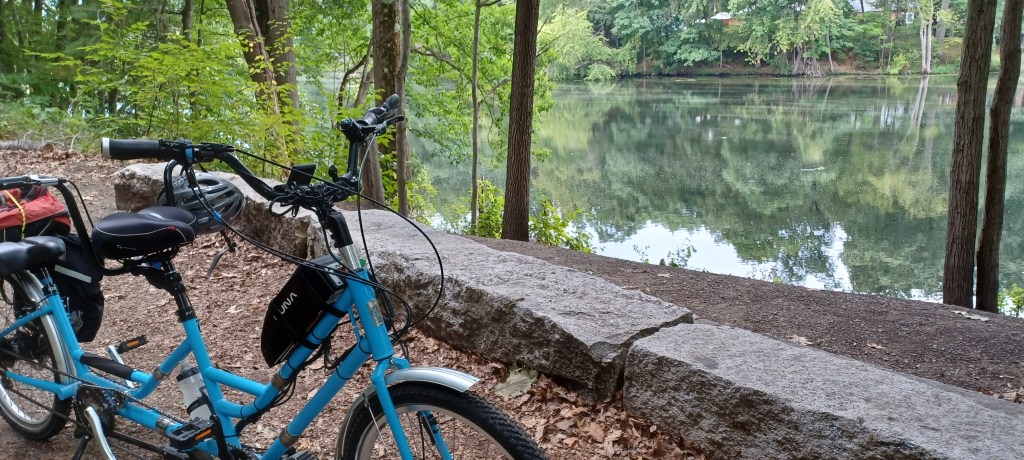
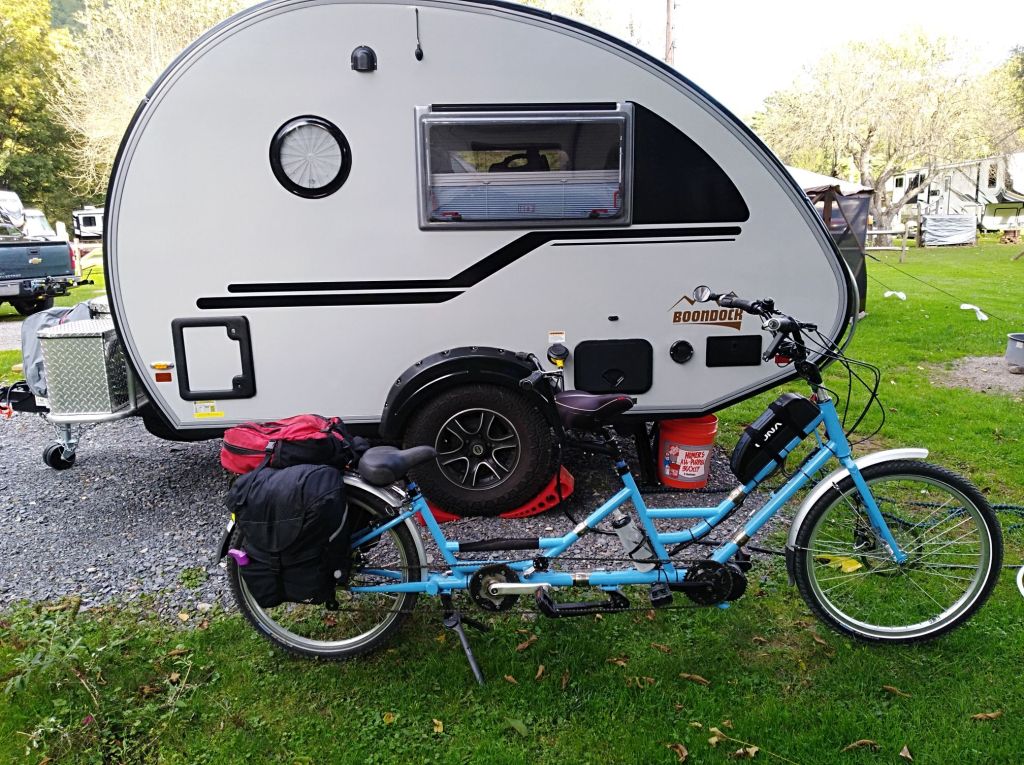
You never know what will happen when you get outdoors. This trip started at Ayer, MA and took us all the way to Nashua, NH on the Nashua River Rail Trail. We brought along our mascot, Stormy, (aka Smoky.) He’s now Stormy, having donated his previous name to our new kitten. Our tandem bike, Shermy, did great after his international travels to Canada, including two ferry rides. And we almost encountered a black bear on the trail. The bear was quick, crossing the path before we could get a photo, but it was definitely a bear.
We started in the southwest of Newfoundland near the ferry landing in Port aux Basques, and after a week moved about two hours north along the Trans Canada highway to the Port au Port area.
Easy Walk to fossil treesFossil tree (black) in stream
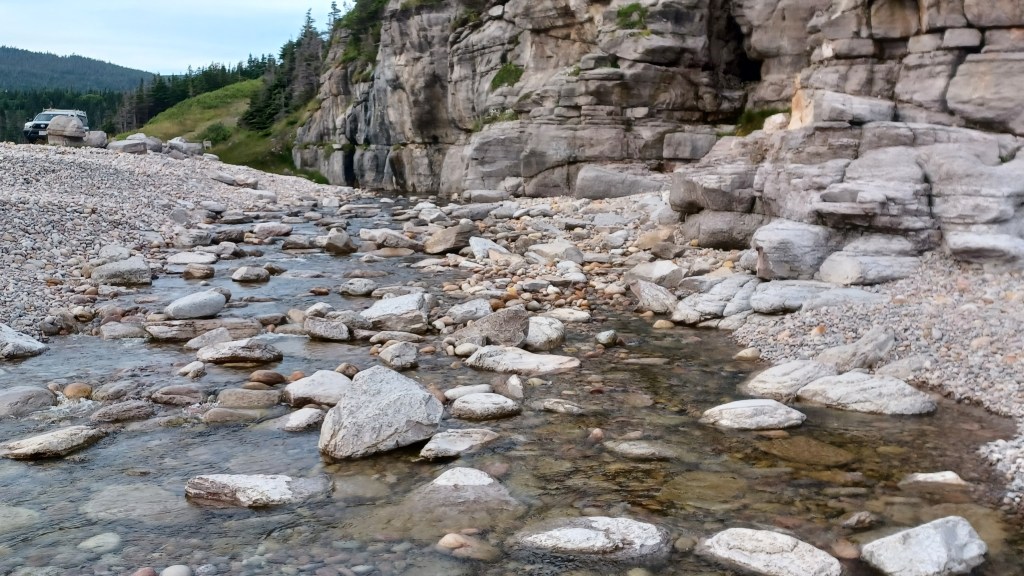
On our way to our next campground we visited the Blanche Brook fossil beds in Stephenville, Newfoundland. The packed dirt path in the sunshine along the brook near a parking area offered solid footing for me. Once we entered the woods the trail continued alongside the water, and for the most part was still an Easy Walk. However, to actually see the fossils, visitors need to get down the banks of the stream and wade into the water.
We had just had some heavy rains, filling the brook and making for very tricky footing. I stayed on shore while my husband rock-hopped out to the small island in the brook where he took his shoes off and waded in for a closer look. He got some great views of the fossils, preserved trees turned to rock. We were the only visitors when we stopped on a July morning. Like many other places while in Newfoundland, we often found these outdoor sites to be surprisingly uncrowded.
Doing my part…
A private campground was our home base for several days while we explored several areas that offered some great Easy Walks. After leaving the fossil beds we moved on to a private campground in Stephenville, our home base for several days while we explored several areas that offered some great Easy Walks. Power and water hookups at provincial campgrounds are limited. Since we needed some power to recharge our camper batteries, rather than stay at another provincial park, we chose to stay a night or two at a campground that had “hookups.”
Both national and provincial parks are great places to visit in Newfoundland. Besides these government sponsored outdoor spaces, we were surprised to discover stunning outdoor places that local communities oversee. Even more surprising is that a number of them that offer Easy Walks in areas that are otherwise very difficult to access. Once we were settled in the campground we headed back out to explore nearby Sheaves Cove.
Hidden fallsView of the marsh from path to the falls
Sheaves Cove offers not just one, but two Easy Walks. The creating an maintaining of these trails has been a labor of love, and I really appreciated the care that went into making these trails accessible for many of us. The first trail we explored took us down to the Hidden Waterfall. Quite obvious once you have driven down the dirt road leading to the parking, this waterfall is not visible from the road unless you know where to look.
Stream near the parking area flows from the waterfall through the marsh into the sea
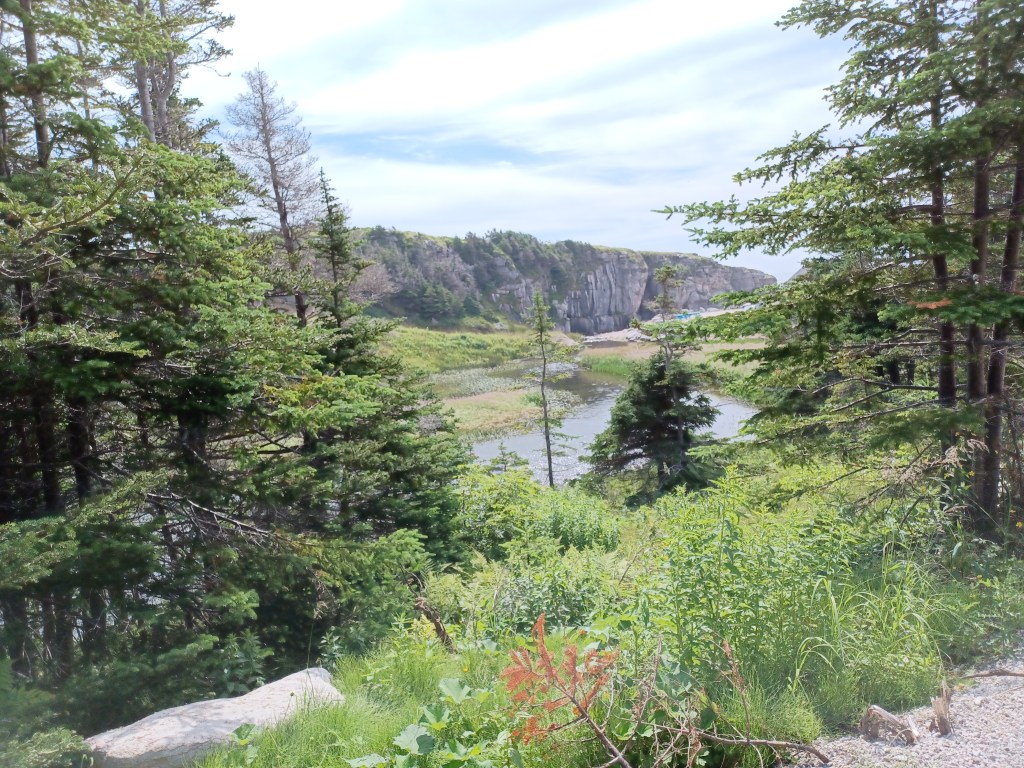
The water from the falls flows out through a marsh and empties into the sea right next to where we parked. The path down to the falls is a maintenance access type road, quite broad, packed gravel, with a gentle incline that takes you to the bottom of the falls.
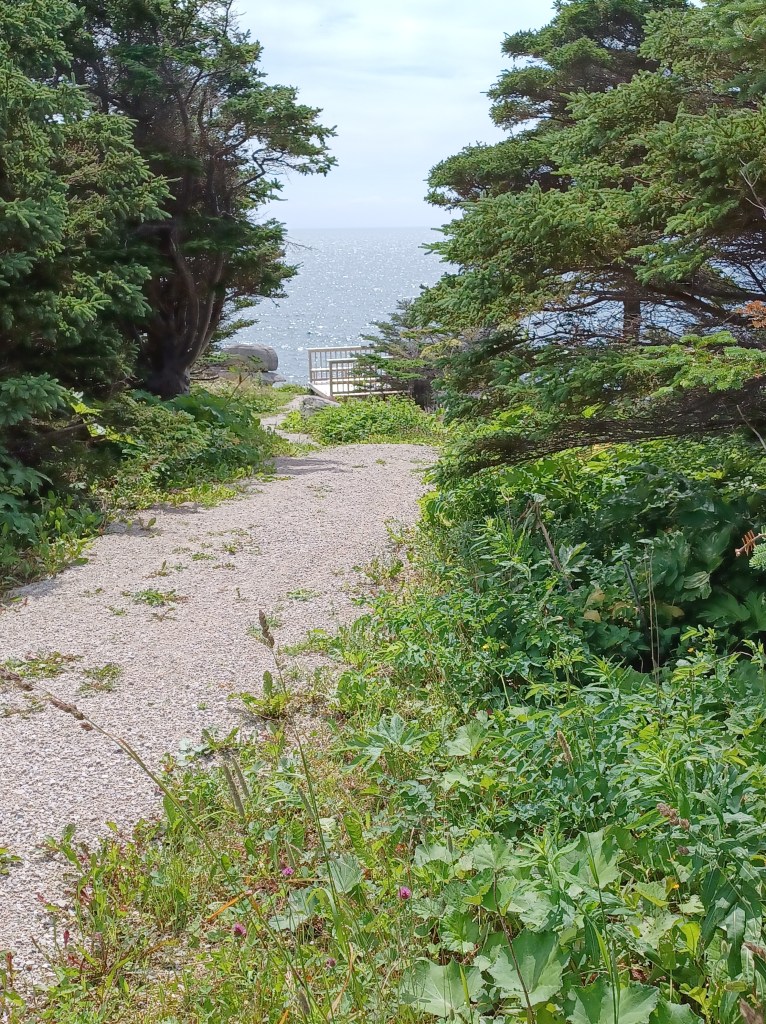
Gravel paths lead to coastal viewing platformsCapstan, used to pull boats ashore
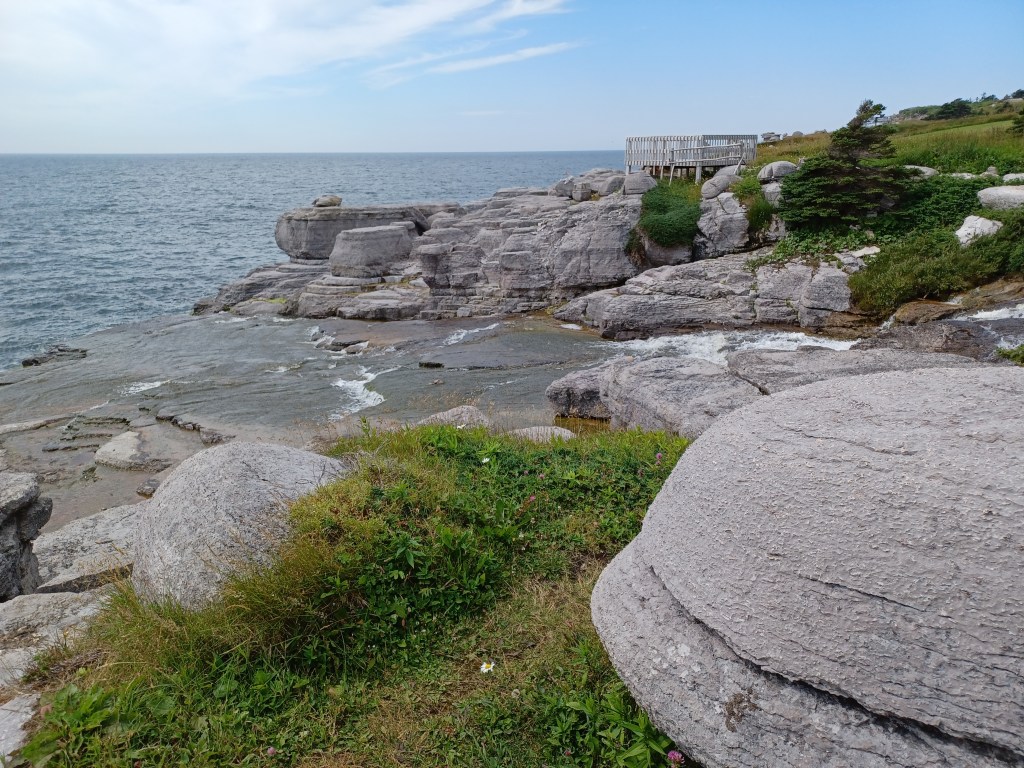
On the opposite side of the parking lot is a trail that invites visitors to stroll along the cliffs overlooking the ocean. This path is quite wide, packed gravel and offers amazing views of limestone formations right along the shoreline.
Limestone mushroom along the cliff
Viewing platforms long the way present opportunities to get even better views of the area than you can see by walking along the top of the cliffs. Some limestone formations reminded me of mushrooms, though certainly not very tasty.
Water cascades down the limestone cliff into the sea
Yet another waterfall in this spot tumbles down the cliff, crossing the trail, cascading directly into the sea from the rocks just above the waterline. A bridge allows visitors easy access to the other side of the water. We spent hours taking in the views, resting at the viewing platforms and looking for whales. No luck with whales on this outing, but we spotted them on other visits during our trip.
Humor on the trail
We found more Easy Walks in the Port au Port area that I will leave for our next post. On our next outing, we encountered a provincial park that offers more Easy Walks, and clearly has a great sense of humor. Till then, happy trails!
Lots of us grew up watching Saturday morning cartoons. But not so many get to really hug Yogi Bear. A series of cimcumstances brought us to Jellystone Park near Natural Bridge, Virginia. We feared the place would be filled with noisy campers, but instead, we arrived early in the season and had the place to ourselves.
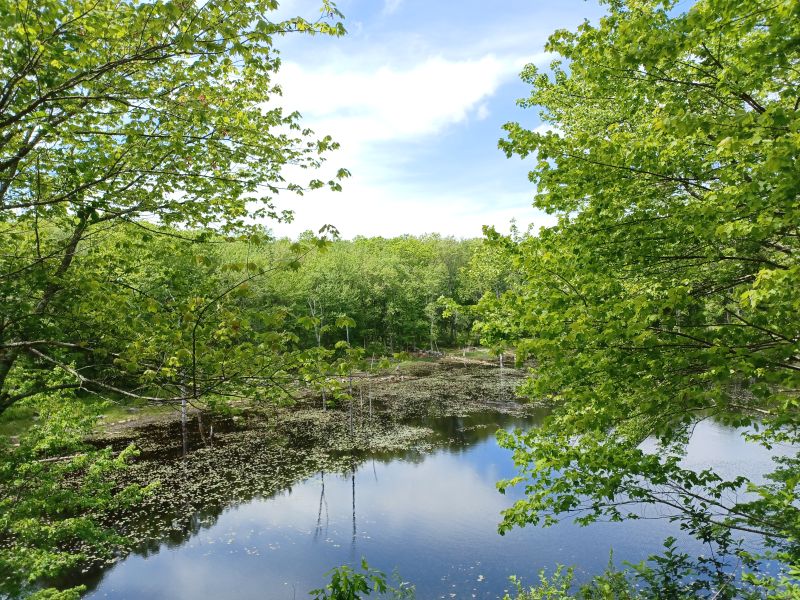
Along the Airline Trail near Hampton, Connecticut. Difficult to see here, but this pond must have been flooded by beavers. Stone walls from the shoreline lead all the way down past the water’s edge
In our travels with our camper, we have found state forests to be a great resource, often providing camp grounds where we had great experiences. Many have trail networks, one state forest we stayed at had a handicapped accessible overlook, and others were simply great spots to stop and enjoy the scenery.
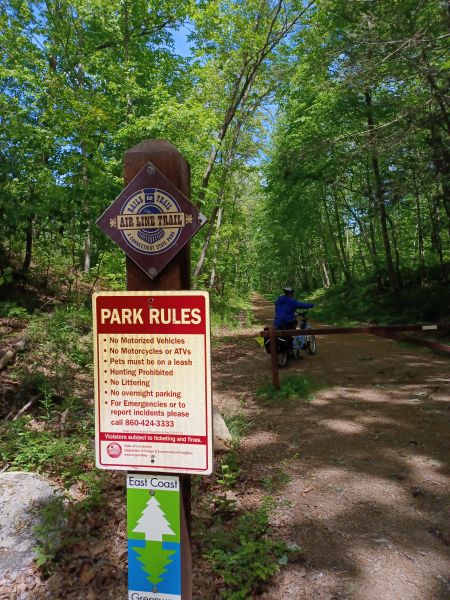
One access point along the Airline Trail
On our way to a rail trail in Connecticut, we stopped by a state forest we spotted along the way and discovered a gem (and access to yet another portion of the same rail trail we had been headed toward). The James L. Goodwin State Forest in Hampton, CT offers multiple options for enjoying the outdoors. The boat ramp allows small craft to enjoy the pond. The Conservation Center, located inside the State Forest, offers education programs. When we looked at Google maps we realized that the Airline Trail passes directly through this same state forest.
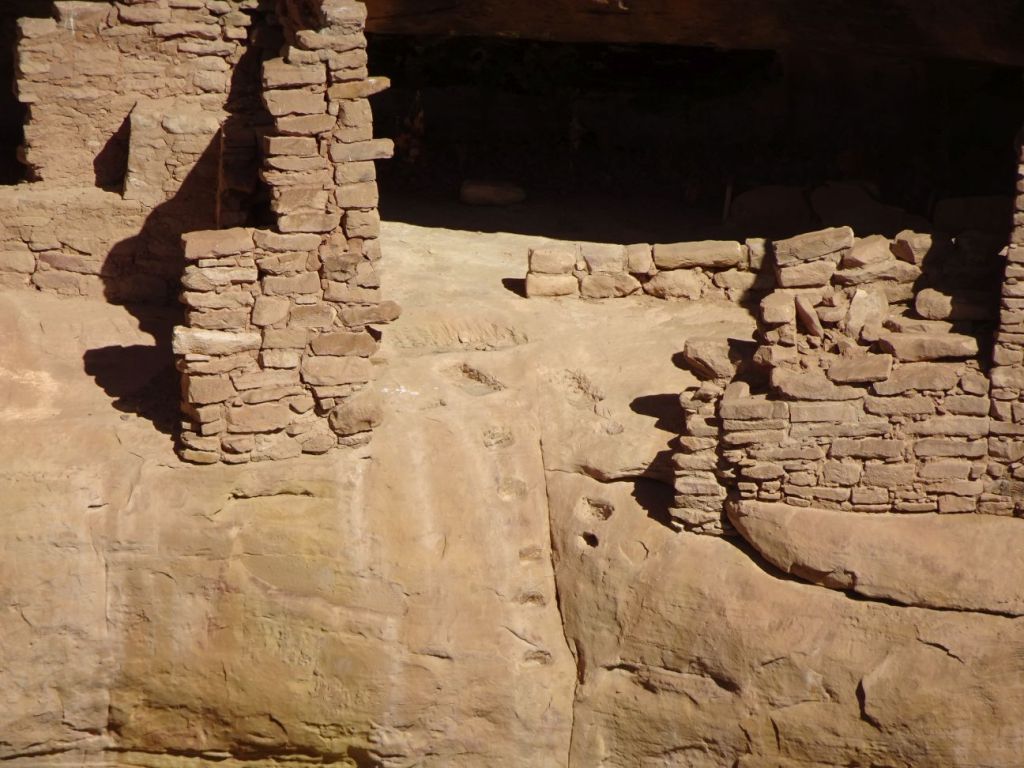
View of one of the cliff dwellings at Mesa Verde–see those impressions in the rock, center of photo? Those were steps to climb up the rock face. Not an Easy Walk at all!
We had another goal on our travel beside bicycling in Glenwood Canyons, and that was to allow me to take the self-guided tour of Carlsbad Caverns National Park, in Carlsbad, New Mexico. From Utah, that’s a long drive, so we took our time and stopped a few places in between. Not on our schedule, but too good to pass up, was Mesa Verde National Park, which ended up being on our way. We spent two days quite nearby, allowing for more relaxed visiting of the park. We stopped near the end of October, when the park was essentially closing down for the winter, so some aspects of the park we had hoped to enjoy were unavailable to us. What we did see still made the visit worthwhile.
Traveling out west in the fall is a balancing act when you have a camper. The scenery is even more stunning than at other times of the year, and the risk of freezing weather is increased. Freezing means no running water (I know–a modern luxury of camping in a camper with wheels.) We had been in Colorado and weather reports promised freezing temperatures, yet a few hours west of us in Moab, Utah, the weather was warmer. Thus, an unplanned, but welcome diversion west to Arches National Park was our next stop on our western tour.
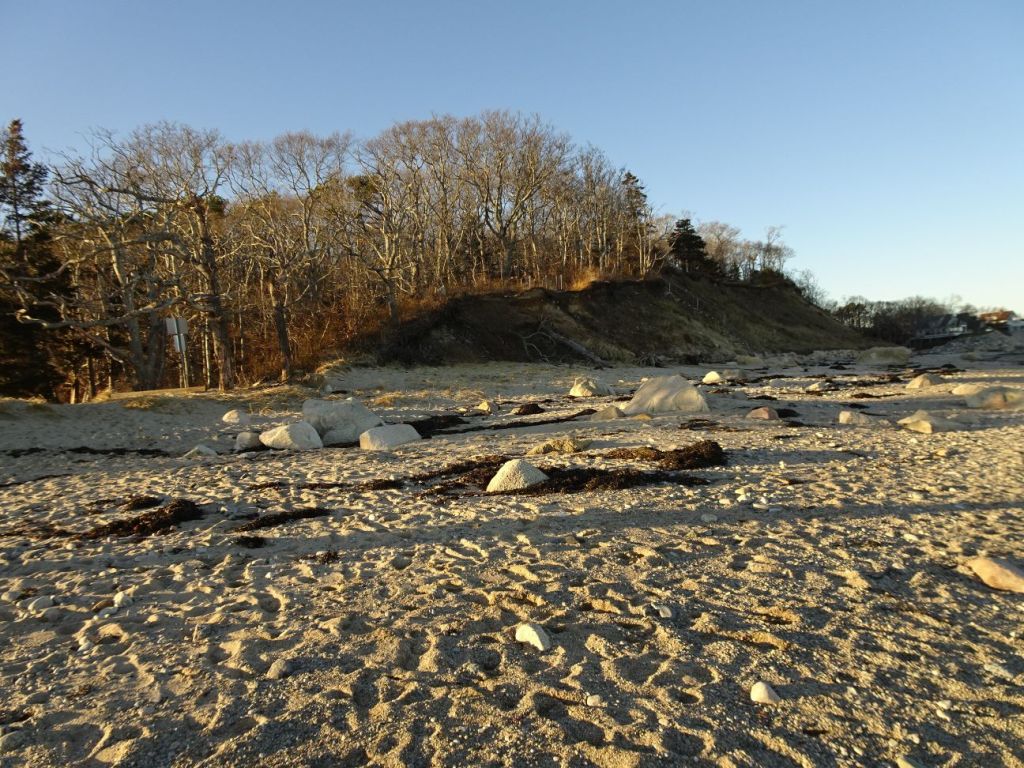
This was our second visit to Ellisville Harbor State Park in Plymouth, MA. On our first visit in August, we were led to believe the path to the shoreline was at least a mile. Since my “on foot” range is about two miles, this would leave no energy for actually walking on the beach, plus it was warmer than I could risk in August. We chose to head on, and ended up at Shifting Lots Preserve, another open space quite nearby. We returned to the state park on a cool day in December, and decided to try reaching the beach. Turns out, the trail is closer to a half mile out, well within my capabilities when the weather is cool outside.
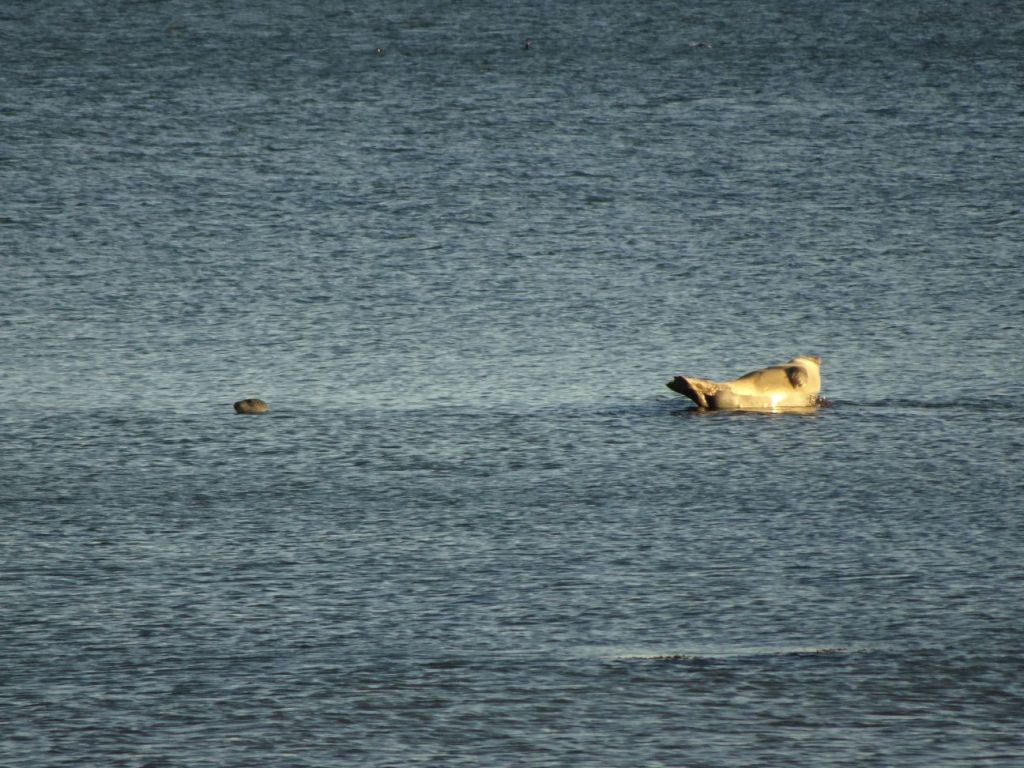
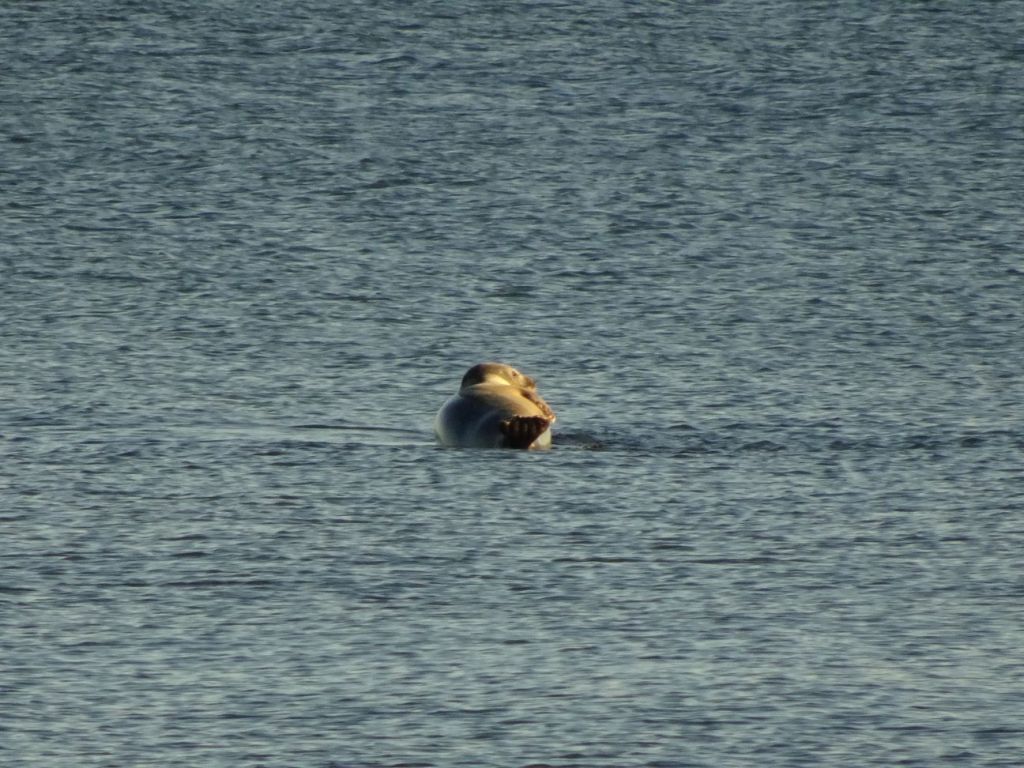
What we didn’t know was that this relatively quiet state park is a favorite spot for seals to hang out in at low tide, just off shore. What I at first mistook for a large sea gull about fifty yards off shore on a rock turned out to be a reclining seal, lolling about as the tides rolled under him (or her). Nearby, presumably jealous seals hung out, perhaps hoping the resting seal would give them a turn on the rock. Not a chance. Our seal persisted in staying on the rock for the hour or so we spent walking the beach near sundown.
This seal kept wallowing in the waves, rocking back and forth. No sleeping allowed as the tide began its return trip.
We counted in all about a dozen other seals along the shoreline, only fifty yards or so off shore. The more we looked, the more we saw. We usually get excited seeing one or two seals. This was more at one time that we’ve seen on our walks, except perhaps on the California Coast (and those were sea lions).
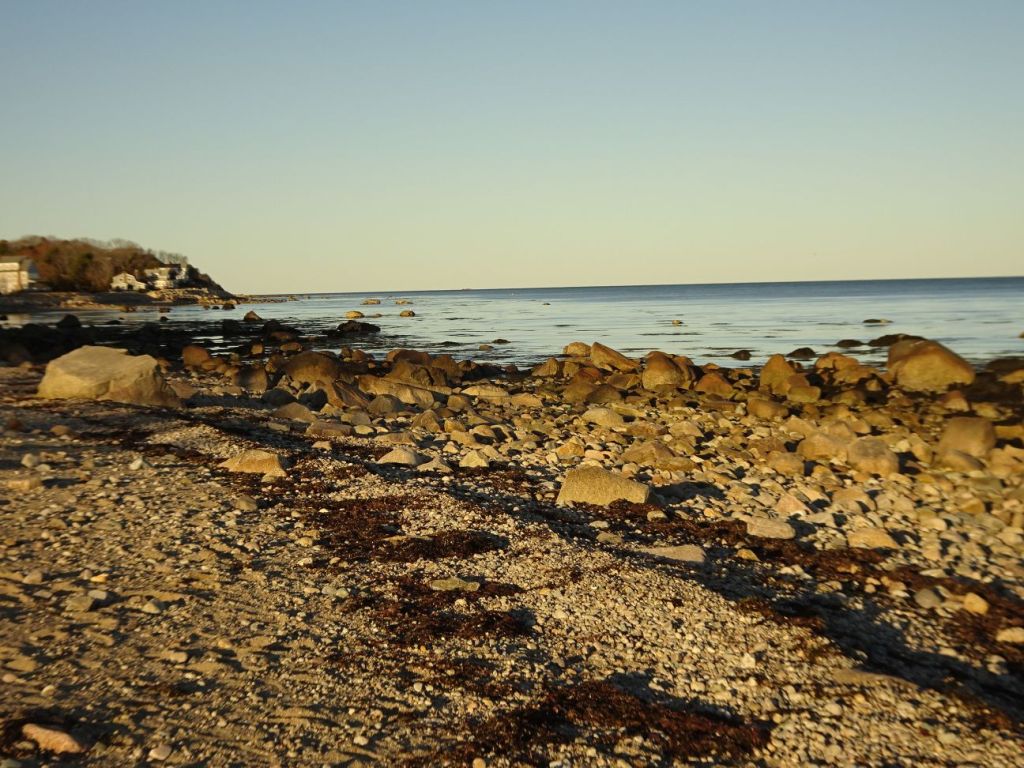
Rocks at the tide line made walking challenging. Soft sand farther from the shore made walking tough for some of us as well. The resting seal can be seen in the photo on the left, binoculars helped us see him better.
Unlike some beaches, even at low tide, we found the sand there to be quite soft. Closer to the water the beach was rocky and more difficult for me to manage. Since it had been a relatively Easy Walk out to the shore from where we parked, I was able to enjoy my time near the water without too much pain. My hiking poles were really helpful in keeping me upright in the soft sand.
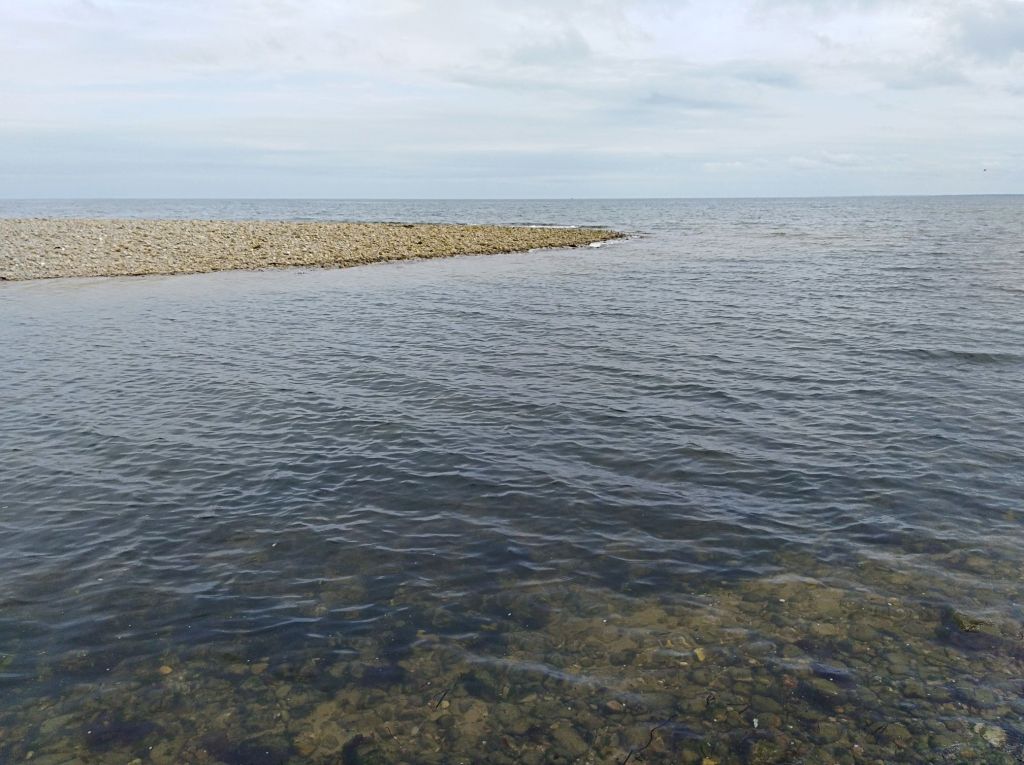
On the left, view looking towards the marsh area, in the right photo, the stream flows out to the sea. Shifting Lots is just across the stream.
We walked south on the beach toward the outgoing stream flowing from the wetlands that are part of the state park.
The same stream, from the Shifting Lots Preserve, at high tide
On our August visit we had walked on the opposite side of the stream, at the Shifting Lots Preserve. That visit had been at high tide, and we were not tempted to try to cross the stream over to the Ellisville Harbor beach side of the stream. Low tide still offered a steady stream, more than we were prepared to cross without waders.
Dusk changes the feel of the air. The setting sun brings a glow to the surroundings
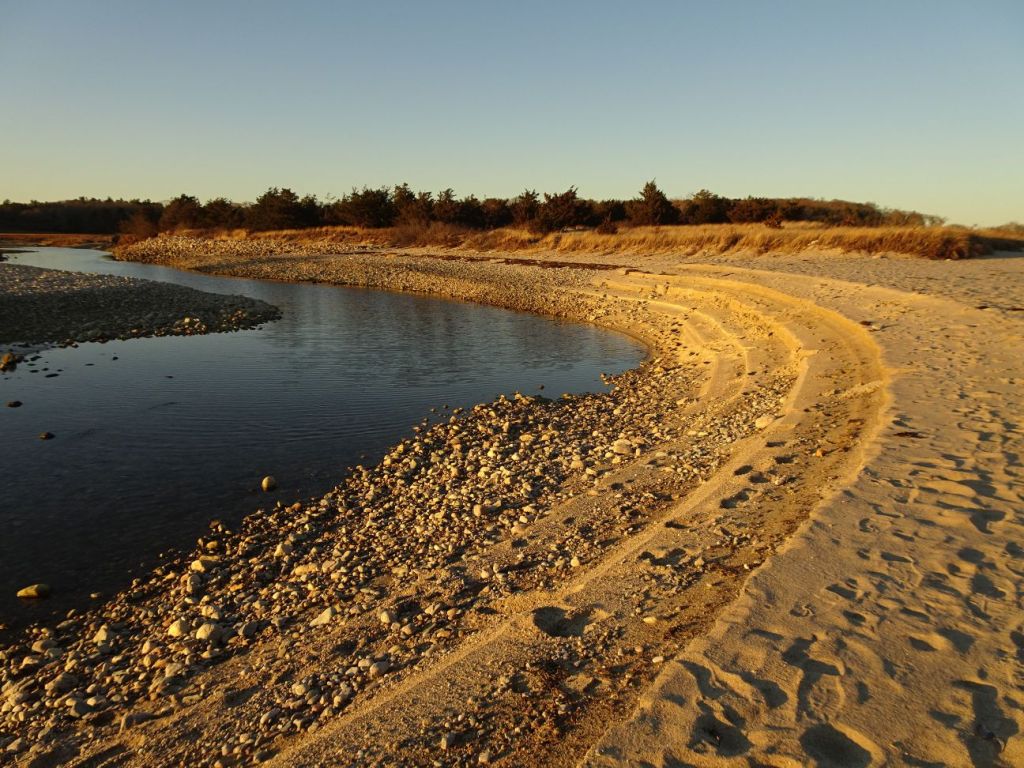
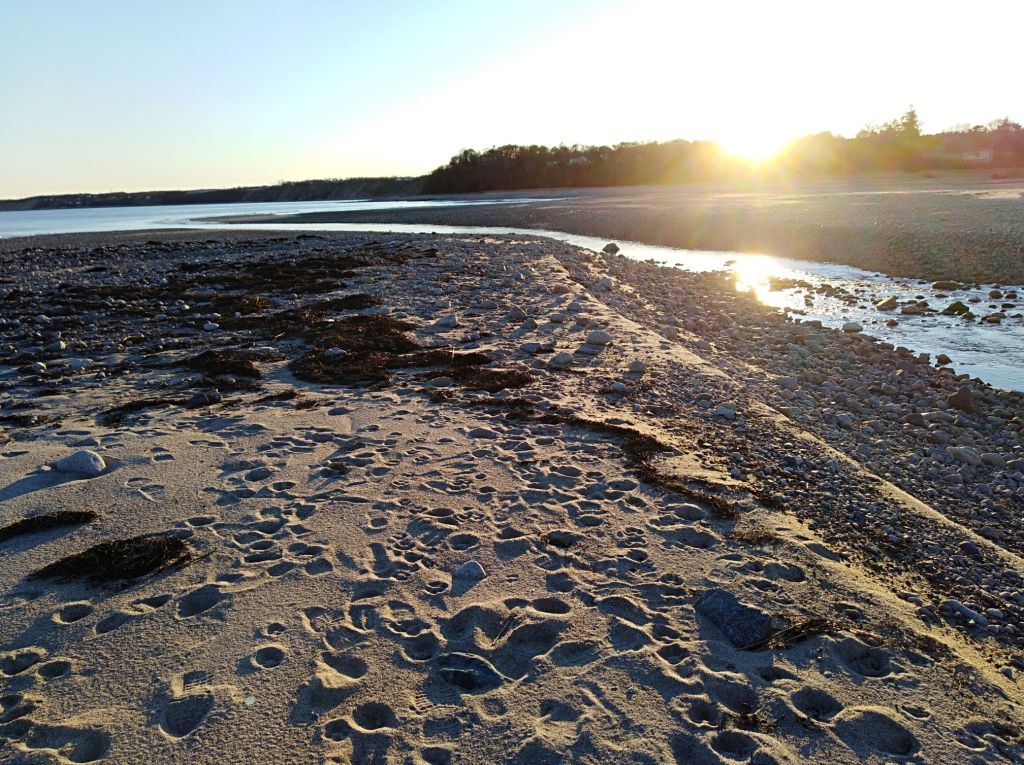
This visit, we got a chance to see the other side, and low tide revealed a very different complexion of the path the water takes to get to the sea. Many streams on the east coast that reach the ocean are encumbered by development, so this was a treat to walk along and see the water flowing toward the ocean.
If we had spent enough time there, we could have watched the tide shift the flow of the water, pushing it back into the wetlands. Another visit, perhaps.
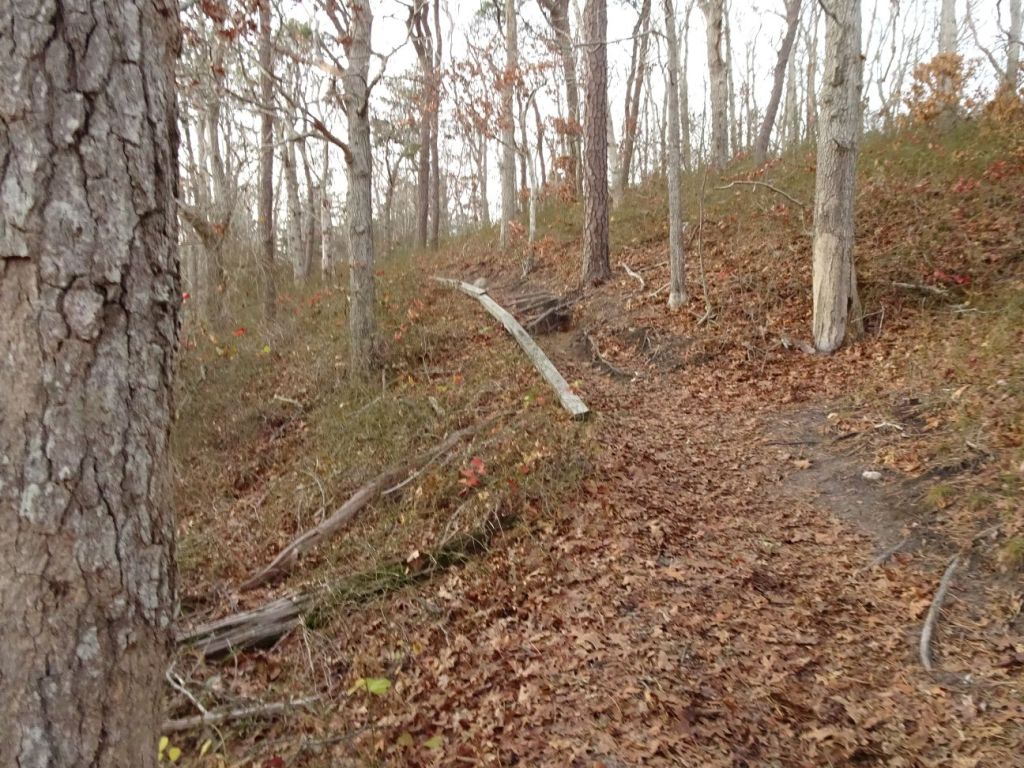
On the left, a portion of the steep trail down to the shoreline, on the right, the flatter packed dirt trail leading out to the shore
All but the last section of trail to reach the beach counted as an Easy Walk for me–a few rocks, some tree roots, a very firm clear path, with lots of views of the ocean. In warmer weather there will be fewer views as the hardwoods in the area will leaf out, obscuring the view in all but a few spots.
Erosion has made access to this stretch of beach pretty challenging
That last section to reach the beach is a doozy. Beach erosion has left substantial cliffs along the shoreline. We went to the end of the trail and found a very steep, rocky path down to the shore (which I declined to try to attempt). We had noticed several side paths on our way out to the end, so backtracked to the path closest to the end and found an easier path. This path is still quite steep, especially at first, with tree roots that act as steps–sort of. I required assistance navigating this section of trail, even with my hiking poles. Thankfully, I brought along a willing helper who provided the needed support to get me safely to the shoreline.
View from the trail, overlooking the marsh
Ellisville Harbor State Park is open dawn to dusk. There is no charge, the beach is unattended, and dogs are unwelcome May to September on the beach. Even when we visited in August the parking area was not full. The longer walk to the beach may discourage summer beach goers, but this destination is pretty high up on my list, regardless of the challenges, for the hope of seeing seals at low tide. Happy trails!
We could have spent an entire month exploring the Glenwood Springs area, in addiiton to the Glenwood Canyon rail trail. As it was, we found two additional well maintained rail trails within a few miles of where we stayed in the area. Glenwood Springs offers amazing walking opportunities throughout the town. The downtown has trailheads for both the Glenwood Canyon trail, as well as the Rio Grande Trail, that follows the Roaring Fork River.
We planned to stop at other rail trails along the way from our start in New England, but our goal was Colorado. We had enjoyed several days in Pine Creek Gorge, PA where we pedaled perhaps half of the sixty-two mile trail. Travel always offers surprises, and our first “surprise” rail trail we had never heard of was the Katy Trail, a 240 mile linear state park that essentially travels across the width of Missouri.
Our family set out in September with our new camper, our adaptive bicycle, (and a whole lot more!), determined to enjoy places along the way where we could explore trails with out adaptive bike. It was a journey in and of itself to simply get the tools in place and find a camper that was not only available, but which our truck was able to transport. (Weight becomes an important concern when towing anything). It was a learning curve, and for sure, these first days, we were at the bottom of it!















 Marjorie Turner Hollman