
Marjorie Turner Hollman helps nonfiction authors self-publish their books. She is also a disability advocate, sharing information about Easy Walks (not too many roots or rocks, relatively level with firm footing, and something of interest along the way) in open space. Let’s get in touch.
If you enjoy sitting down with a book, I want to make a bold suggestion. You have most likely read something that changed your life.
Spending significant time on anything will have an impact on how you look at the world. If you spend your time in the company of books, depending on what you read, a book might offer insights into your own life. A book may have inspired you to make different life choices from what you imagined. Perhaps you discovered an entrepreneurial endeavor you had never before considered.
A book I read recently stopped me. The author wrote something along the lines of, “books changed my life”. She was reflecting on the role, big picture, of reading, and how books are an essential part of her life. As impactful books can do, this single line in one book prompted me to wonder, What books have changed my own life? I started a list of pivotal books that have had profound effects on my life choices, but also in how I see the rest of the world. After compiling my list, I started writing, thinking through what exactly changed me because of these written words.
Curious? Here’s my list:
As a teen, I read C.S. Lewis’s The Screwtape Letters. It was probably the first book I had read where I found myself nodding in understanding. This was fiction that connected with my lived experience.
In this small volume, Lewis uses the framework of a senior devil (Screwtape) advising an apprentice tempter (Wormwood), whose goal is to recruit souls for their Father Below. Human souls would provide food for the insatiable hunger of the inhabitants of their underworld home. Within the letters from Screwtape to Wormwood, the experienced tempter offers advice and reflections on the human condition, exposing familiar human foibles in the process. Small portions of Screwtape’s letters have stuck with me.
In one missive, Screwtape laments that, sadly for them, all true pleasure actually originates from God (the enemy). He regrets to inform Wormwood that the only recourse they have is to distort for their own purposes these sources of joy. But, Screwtape continues, “our father below” promises that their researchers expect a breakthrough any day. He assures his apprentice that they will be successful in creating an original pleasure, made for their own purposes. Alas, until then their only effective tactic for effectively luring their subject into the realm of “Our father below” is to corrupt these true sources of pleasure.
I was (and still am) challenged to examine experiences that might appear pleasurable at first glance. What is the underlying pleasure? How might it be distorted? Other parts of the book come to mind occasionally, but I continue to ponder this one conversation between two devils. It always makes me smile.
Lewis also stresses in this same book that the most powerful response we can have to forces of evil is to laugh. Evil hates being made fun of. This is a principle I continue to bear in mind, when the forces of evil appear to be prevailing. Claiming the ability to laugh in the face of terrible events is life-giving.
As a young mother, I was gifted Thomas Merton’s autobiography, The Seven Storey Mountain.
Having grown up in a pretty conservative, non-liturgical protestant church, I had never heard of religious contemplation, nor had I ever been exposed to monasticism. Merton’s autobiography of coming to faith within the Roman Catholic Church was a revelation to me. His experience within the protestant church was quite different from my own. He had found only shallow, unsatisfying teachings in the protestant church, while I had (and continue to have) found challenge, inspiration, and direction within that same institution
The Catholic church introduced him to the historical Christian church and the contemplatives who wrote extensively through the centuries about their faith. His description of monastic life introduced me to very different ways of thinking about prayer. “Your work is your prayer,” he explained. Rather than viewing mindless tasks as boring or onerous, he suggested that this type of work is an opportunity to focus on God, rather than the tedium of any specific activity. For all I had heard or experienced over the years of prayer, his writing shifted my understanding of this essential aspect of living in faith.
I was also deeply challenged by his assertion that if the eucharist is indeed the actual body of Christ that is received when partaking in holy communion, that is, having the body of Christ within you, how shall we then live? I do not embrace the literalness of transubstantiation. I do, however, think often about the idea that if we carry in us the body of Christ through faith, (which I do believe), how should this influence the choices I make and the responses I offer to those I meet every day?
His writing helped me understand that I had always looked at life through the lens of a contemplative. “Hmm,” I thought, as I continued reading Merton, “as a young, married mother, nursing my firstborn, it appears that I may actually be a non-celibate monk (well nun)!” Merton’s writing transformed my attitude toward prayer, work, and how I see myself and my role in this world. Pretty heavy lifting for one book, and there it is.
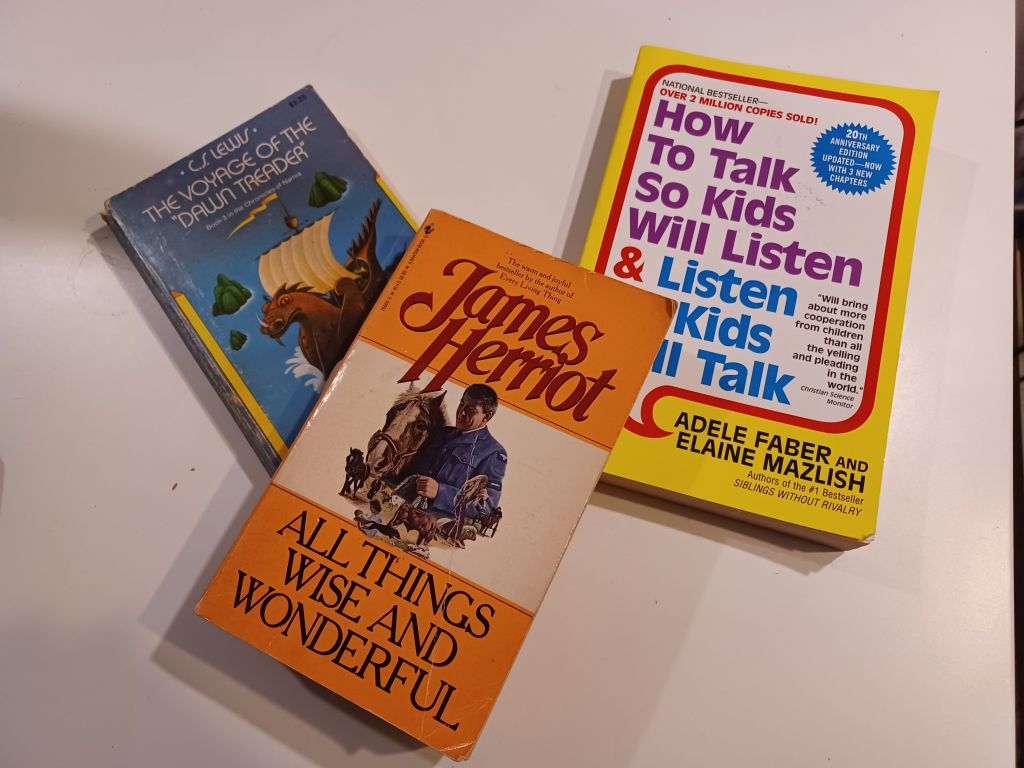
How To Talk So Kids Will Listen, And Listen So Kids Will Talk
I have great kids. When they were little, they were very normal children, sometimes happy, always curious, and often resistant to what I asked them to do. As a parent, I became aware of how few resources I had to deal with the normal challenges of parenthood. My reactions to their lack of cooperation were out of proportion to their pretty normal kid behavior. I read books that suggested various approaches to parenting that just did not work for me and my family.
One day my friend Sue loaned me a book with the comment, “You might enjoy reading this. I found it really helpful.” The book, How To Talk So Kids Will Listen And Listen So Kids Will Talk, changed my life, perhaps more profoundly than any other book I have read. I’ve given multiple copies to parents struggling with how to manage parenting challenges.
This book made clear that I had no clue how to be proactive with my kids. I was raised in a reactive environment. When things went wrong, assigning blame was the default response. Shame was a tool to get us to comply. Parental instructions were less than clear. Unspoken expectations produced confusion. My parents did many things well, but communicating clearly both needs and expectations was a skill set that was lacking.
I learned strategies for working with my kids in a nonpunitive manner. Each chapter talked about the “why” specific approaches were more effective than more traditional parenting patterns. The end of each chapter included a list of steps to use for fostering clearer lines of communication. I copied these lists out and taped them on my fridge and on the bathroom mirror. Keeping these reminders front and center, I began altering my word choices. Feeling as though I was learning a completely different language, I stayed in the discomfort and the awkwardness of using phrases I had never heard spoken to me, myself. My children began responding differently as I incorporated phrases and concepts I learned.
I can’t list all the concepts taught in the book, but some have become habits I use to this day. A few come to mind: say it with a word, or a phrase, instead of a lecture; write concerns or complaints down as a sign of respect; instead of heaping praise, describe what you see; and offer limited choices.
My most frequently used approach, which I put to use to this day, is that when we are faced with impossibilities, to grant a wish in fantasy. Of all the wisdom I gleaned from reading this book, offering this gift has had the most profound effect on others, and myself. Life will often present circumstances in which we cannot fix what is happening. I often find myself saying, “My magic wand is out to the shop. I’ve heard it will be fixed any day now….”
Don Azlett’s housecleaning books
My life was turned upside down when I confronted the reality that my marriage was dissolving before my eyes. While staying at a friend’s house to figure out my next steps, I spotted a book on a shelf of the bedroom I was staying in, written by Don Azlett.
The author created a business centered on household cleaning products, and wrote multiple books focused on housecleaning tips and clutter control. The book he wrote that changed my life insisted that, “You too can start a housecleaning business.”
What a remarkable concept! I had never been able to keep my own house clean, nor had I ever seen anyone dust their own house. A babe in the woods regarding starting a business but desperate to figure out how to care for my kids, I mentioned the idea to a friend. She said, “Great—I’ll hire you and you can clean my house. Don’t worry, I’ll teach you everything you need to learn.” This was the start of my first entrepreneurial endeavor, and was how I paid my bills for the next seven years. No one was more surprised at the success of this business than me.
Oliver Sacks’s neurological case studies
In the early days of my healing after devastating brain surgery that left my right side totally paralyzed, I discovered the writings of Oliver Sacks. ?
His case studies of various patients living with neurological challenges gave me words for the strange bodily sensations I was experiencing as I began to heal. Regaining movement in my arm and leg did not happen in a linear fashion. Sudden changes in balance, function and stability sometimes occurred instantly but unpredictably.
Oliver Sacks wrote numerous case studies of his neurology patients and weird symptoms they exhibited. One particular story talked about how our “natural” center of balance is in fact a neurological manifestation of how our brain maintains our ability to stand upright.
I had regained movement in my right leg but my balance was precarious. After reading Sacks’s book, I realized that my center of balance was actually located around my knees rather than my hips. I felt as though I was walking about on stilts. Each step I took offered another opportunity for me to topple over.
Shortly after recognizing where my balance was situated, I rose from my favorite chair and walked toward my kitchen. Approaching the kitchen sink I “heard” a voice say, “You have your balance back.” Right behind this odd pronouncement, a second voice countered with, “You think you have your balance back.” Before I could figure out where all this was coming from, a third voice chimed in. “You hope you have your balance back.”
I do not normally hear voices, nor have I heard any since then! Unsettled and confused, I reversed course, dropped back into my chair and waited to see what might happen next. After an hour or so I stood, took a tentative step forward, and continued walking. My balance had shifted to my hips. Each step I took felt as though I was flying. Such exhilaration! I am convinced that had I not been given the words and awareness of this neurological function, I might not have recognized the healing when it occurred. Others may view this story differently, but it has always felt like a lodestar in the course of my healing. Over the years I have experienced other sudden shifts in how my body is able to function more normally. This, however, was the most dramatic, disturbing, and ultimately fascinating series of events I have ever had in my healing journey.
After catastrophic brain surgery that saved my life but left me unable to continue my housecleaning business, I turned to writing and found a niche in journalism, writing for our local town newspaper. As I regained my health, I kept writing, and cast about for other ways to support our family with my writing. I spotted a book on our local library’s bookshelf, Peter Bowerman’s, The Well-fed Writer. He suggested that writers did not need to be starving artists. Instead, he outlined strategies that could provide ways to earn a good living as a copywriter, especially partnering with graphic designers to provide the words to go with advertising and other commercial commissions.
I soon learned that I did not have the temperament or personality for copywriting, but the book pushed me to create a website for my writing. In his book, the author advised readers to choose a business name that would allow for changing business models since our business focuses might change over time. He specifically recommended using one’s own name. It was one of the most helpful pieces of business advice I ever followed, and has stood me in good stead over the years as my writing focus has changed a number of times over the years.
Other books have certainly touched my heart, provided deep solace, (I call them my comfort books), and provide education and entertainment along the way. I am grateful for every author who has labored to share what matters to them. It’s hard work writing a book.
That’s my list. I’d love to hear your own!
Marjorie






 Marjorie Turner Hollman