
Marjorie Turner Hollman helps authors self-publish their books. She is also a disability advocate, sharing information about Easy Walks (not too many roots or rocks, relatively level with firm footing, and something of interest along the way) in open space. Link to all Marjorie’s books.
LISTEN HERE:
I returned to my home weakened, yet desperate to do anything. After surviving brain surgery that left my right side paralyzed, I was sent to a rehabilitation facility for two weeks. During my stay the staff had insisted we inmates (patients, that is) perform what they called “standing therapy.” We were encouraged, teased, and cajoled into standing for periods of fifteen minutes at a time. Most of my fellow inmates were stroke victims, almost all elderly, and they needed a lot of cajoling. I was much younger than the others, needed no cajoling, and resented the undisguised condescension in the therapists’ voices.
My fingers had regained some movement, but my brain was not sending very clear signals to my right leg. We stood around a table in groups of four or five, an aide standing nearby in case any of us keeled over or decided to sit down prematurely. Our therapy was to play card games or to stack blocks. (My aunt told me that her own sojourn through rehab required that she fold washcloths. I am not sure she had ever done any laundry in her life!)
When presented with a deck of cards, our instructions were to place them upside down then find matches. This was along the line of games of “Concentration.” I was never very good this, and if grades were passed out I would have received an “F.”
Once I returned home, we developed what became a running family joke, pointing out all the things I did that were “standing therapy.” Making my bed, lifting open windows to the fresh spring air, and hanging out clothes on the clothes line were part of my rehabilitation. Each clothes pin I squeezed helped my fingers to grow stronger while stretching out shirts, pants, and underwear to dry.
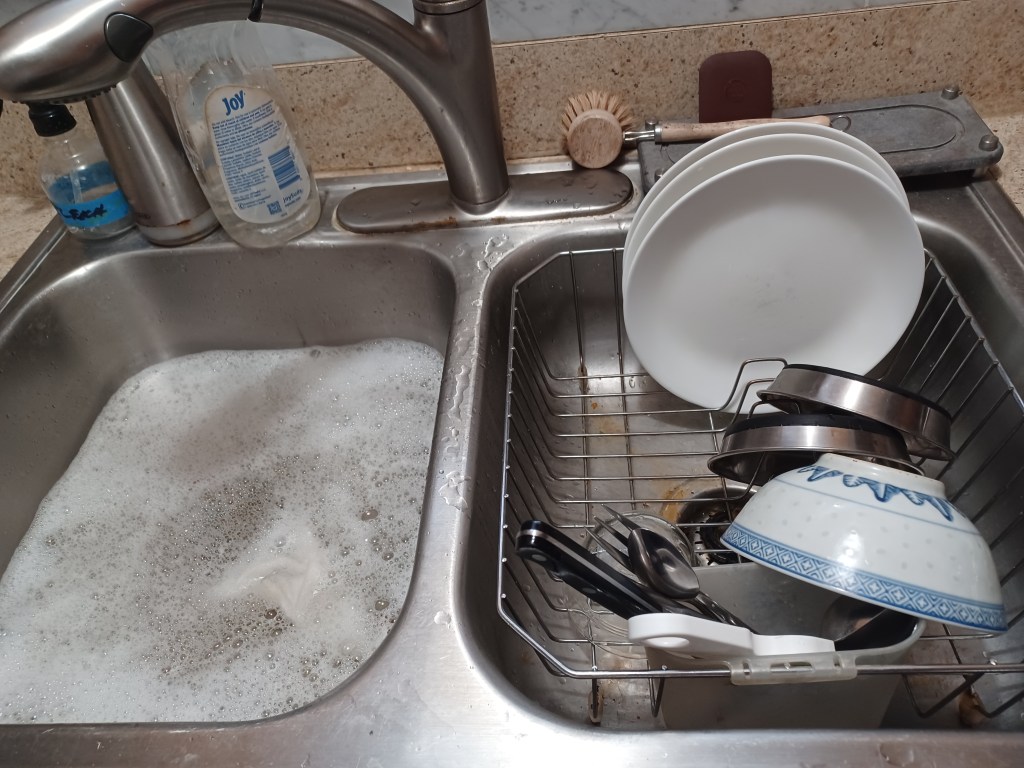
These tasks were helpful in restoring movement, but washing dishes became my favorite therapy. The warm, soapy water soothed my aching right arm and shoulder. I worked to reawaken and strengthen muscles that had been paralyzed and were beginning to regain function. The view at my sink as I worked was (and still is) out my kitchen window, where neighborhood children, including my own, played on the swings or ran about in the yard. The woods at the edge of our yard that spring had begun greening up.
The choice of tableware we used for meals became a point of grace. We decided as a family to put away the heavy earthenware dishes we had always used, and pulled out our much lighter Corelle™ plates. The difference in weight allowed me to enjoy the after dinner cleanup in the warm, soapy water before the pain in my shoulder became too severe. Each session at the sink was a sweet reminder of small yet loving choices my family made for my sake. The real joy was that I had the liberty to stop as soon as it hurt, which varied according to what else I had attempted to do that day.
My parents stayed with us for several months after my surgery. A family member, either a child or grandparent, was always ready and usually cheerful to step in when I put the dishcloth down. Trying to push through, or rushing to finish the dishes myself taught me another important lesson in healing: Trying harder doesn’t always work. When the pain in my shoulder became too much to bear, I had to stop and allow healing to progress at its own pace.
And so, Zen Dishes. As I stood at the soap-filled sink, family members often wandered by. This was not to interfere, just to checking that I was all right.
I usually declined their offers of help with the explanation, “No, it feels so good to do this. Please don’t make me stop.” Thus, our family developed the tongue-in-cheek joke, “Don’t bother Mom, she’s doing her Zen dishes.” And I was.
I still enjoy doing dishes, although I am much more willing these days to be gracious when help is offered. The thing about Zen is that it goes where you are. My life, by God’s gracious gift, has moved beyond doing dishes. If I had not had that time to heal, this might have been a very different story.
This meditation is included in the book, My Liturgy of Easy Walks: Reclaiming hope in a world turned upside down.
Marjorie
 Marjorie Turner Hollman
I enjoyed reading this, Marjorie. You are amazing. Thank you for being such an inspiration.
Thanks for reading Wendy–it means a lot.