Marjorie Turner Hollman is a writer who loves the outdoors. Link to all Marjorie’s books.
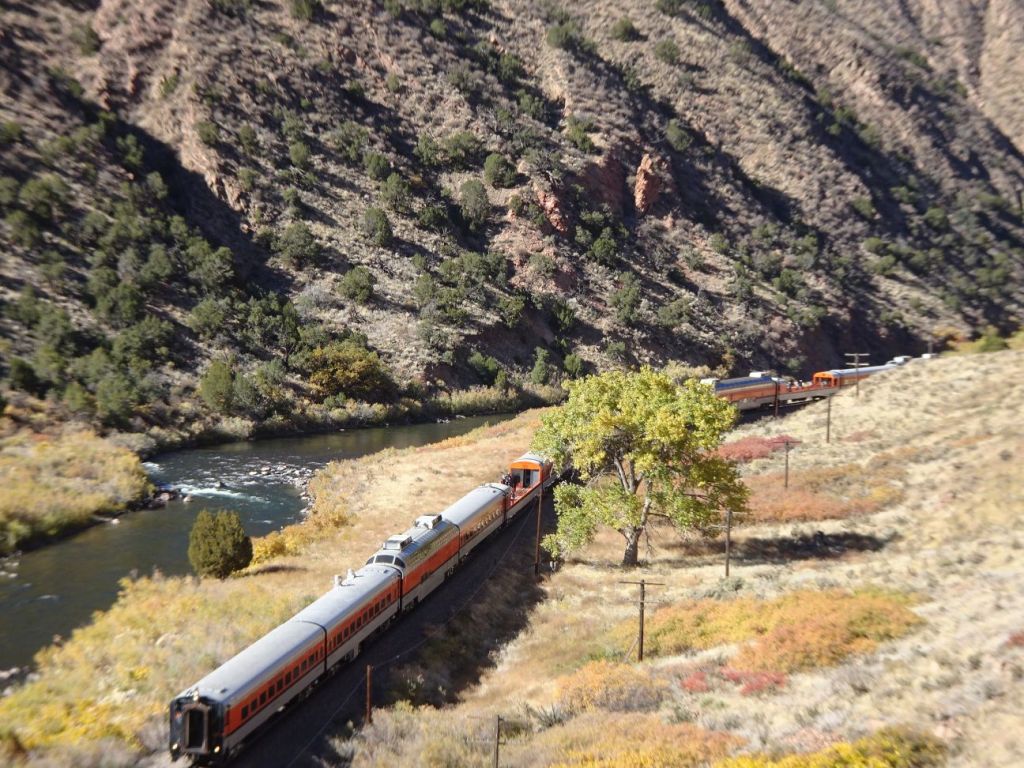
On a cross country trip in 2021, one of my family’s stops was the Royal Gorge near Canõn City, Colorado. What I did not realize until we started sharing photos of our trip with family was that my great-great grandmother, E.J. Phillips, had traveled through this very same area in 1886.
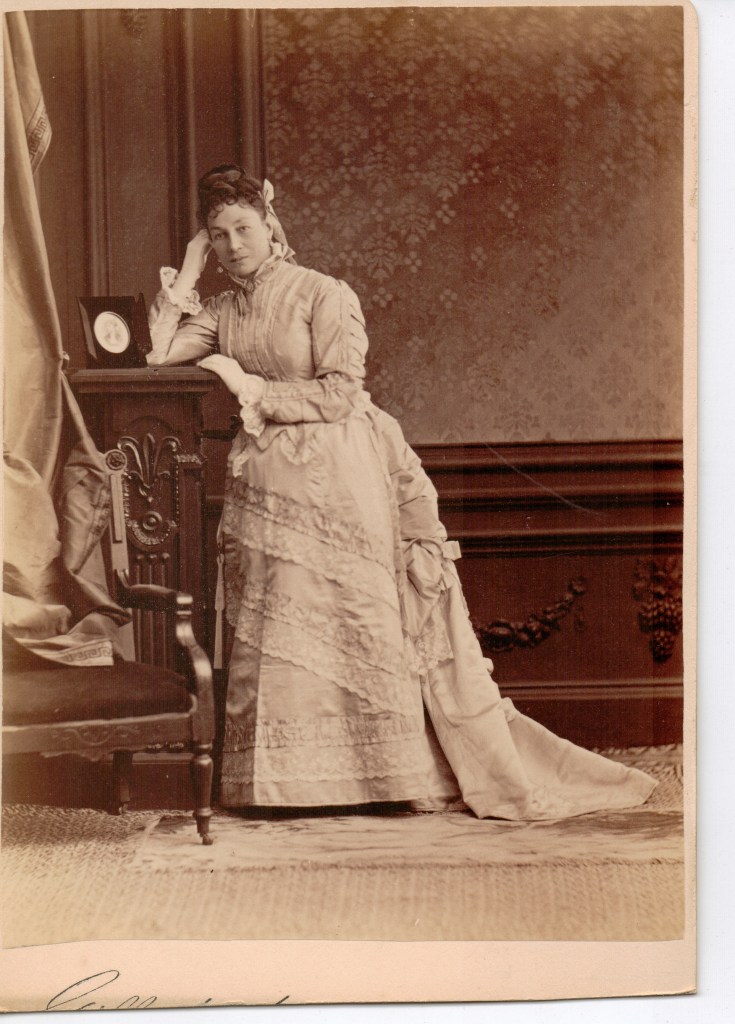
(Photo courtesy of Peggy Spencer)
As a Broadway actress, E. J. traveled by train from New York to the West Coast, out and back seven times during her career performing with Stock Company theater troupes. She wrote letters to her son, my great-grandfather, during her travels (and when she was back home in New York City or Philadelphia). Thankfully he saved her letters, and we are lucky to have them to treasure and learn from. Here’s a brief excerpt:
Wednesday July 28th/1886, West of the Rockies
My dear Son,
Came through Grand Canyon and Royal Gorge by daylight. Over Marshall Pass by Starlight – and over the Mountain Peaks we could look down on the Stars in the distant firmament. It was a lovely sight.
We had two engines pulling us up the Mountain, and as they turned the curves we could see them puffing out flame and sparks and lighting up the way before them. It was better than fireworks at Coney Island. We have the same sleeping car conductor we had on our last journey. It is pleasant so far away to meet someone who has met us before.
Love and Kisses from your loving Mother
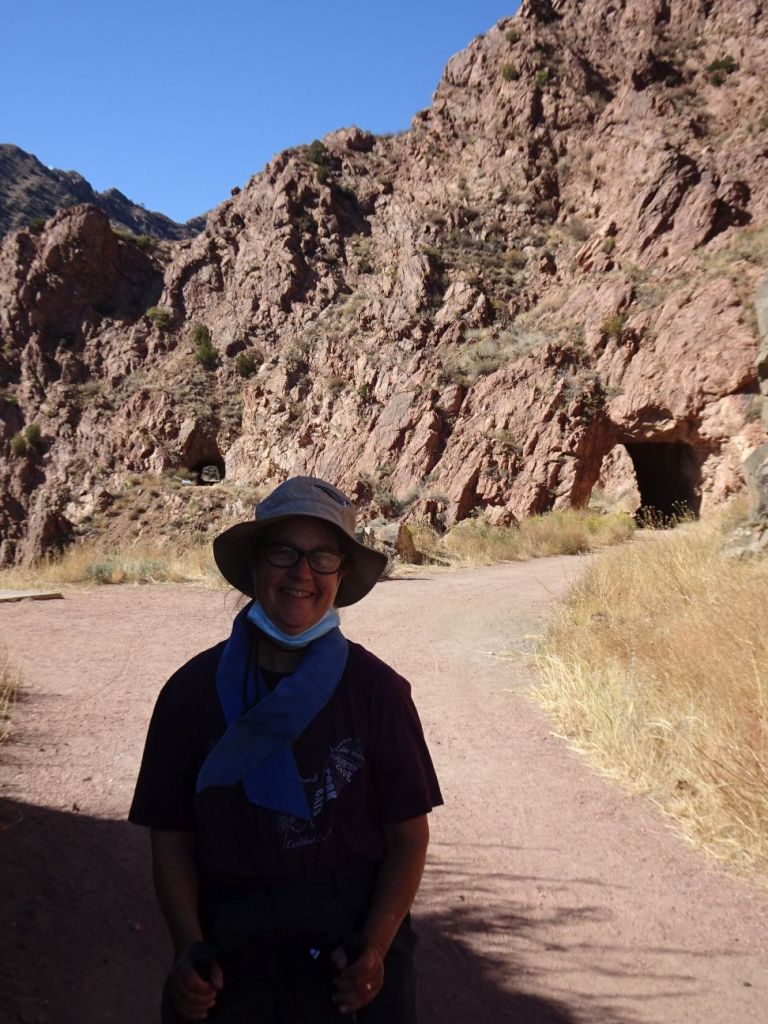

While E.J. traveled by train, our trip was by pickup truck. We towed our camper behind us. She spent nights in a sleeping car; we bedded down under the stars in our teardrop RV. She stopped at train stations, and took some breaks along the way for adventurous outings like riding a mule to the top of Pike’s Peak. We brought our adaptive tandem bicycle with us and walked on a path overlooking the canyon, above the train that carries tourists through the Royal Gorge. The route through the gorge became a transcontinental rail link between Denver and Salt Lake in 1882, just a few years prior to E.J.’s trip.


Modern day rail trails have been developed on the footprint of railroad beds that were built in the past 150 years across the United States. In my family’s travels we have sought out these recreational spaces and have ridden countless miles on these paved or crushed stone dust corridors.
We often think of the people who journeyed by trail alongside the same rivers and ponds that we now enjoy. Did they marvel at the mountains, the waterways, and wildlife that was just outside their windows? Or did they nap or read to pass the time, ignoring the scenery on these arduous trips? While countless books have been written about all things rail related, it is the personal stories that capture my attention.
The easiest route for these rail lines to follow was relatively level ground that offered fewer engineering challenges. Rivers, cutting their way through mountain passes, offered potential pathways for trains. Streams cut through the landscape over time, leaving “benches” above the water, revealing riverbanks of the past. These features lend themselves to hosting the relatively level routes needed for trains. Railroad engines have little capacity to navigate steep grades.
The rail trails we visit are, for the most part, very quiet. They follow along river courses, waterways, through mountain passes, and even along ocean shorelines. These recreational rail trails sometimes take us underneath mountains that were tunneled through years before to allow trains to traverse rugged terrain.
The down side (for the railroad companies) of these beautiful locations is that rivers flood, and ocean storms can pound shorelines. When train tracks are undermined, typically by water during serious weather events, the owners must decide if it is worthwhile to repair the damage or if the tracks should be relocated or even abandoned. We have encountered many rail trails where the decision was made to abandon the rail line.

Train wrecks
Letters my great-great grandmother wrote during her journeys offer tantalizing glimpses of what life was like “riding the rails” in the 1880s. Trains were fueled by coal and spewed clouds of dirty smoke behind them, coating passengers with gritty coal dust. Train cars were hot, especially when crossing desert wastes. Train wrecks occurred with disturbing frequency. E.J. wrote to her son:
San Francisco, July 31, 1886
We should have been here yesterday morning & did not get here until nearly seven. The train ahead of us, which was the regular train, ours being an extra, had the two engines thrown from the track yesterday morning at Blue Ridge [Summit, near Granby Colorado]. We passed the wreck about 2 PM. No cars were upset but the two Engines were turned right over. They said no one was hurt – but I think the Engineer and his companion must have received injuries – but were not killed.
It is very strange in these accidents how very reticent the RR officials are. The Engineer of the 1st Engine was in a house near the accident, and we could not find anyone who could tell us anything about him. New Engines had been procured and the train had gone on before we arrived, so that nothing remained but the two overturned Engines and the “wrecking Derrick train”.
(Wrecking Derrick trains were invented around 1883 to address the need for equipment to clean up the frequent train wrecks that occurred in these early years of railroad development.) While E.J. witnessed train wrecks, she was also on a train during what could have been an incident with many fatalities. As it was, two train cars jumped the track and were destroyed. The car she was in and the one just back of the derailed cars remained on the track but left all the passengers seriously shaken.
The St. James, Denver Colo., Sept 21 1886
My dear Son,
On Saturday morning we had a very narrow escape from an accident, about two miles from the scene of our accident three years ago [1883]. Then five people were injured and one car wrecked. This time no one was injured except one man who nervously jumped from the “Observation car” amongst the rocks, but two cars were wrecked.
At 6 AM we stopped to breakfast. It was very cold – an observation car was put on at the back of the train on which a great many passengers and nearly all our company took seats to view the “Black Canyon” – it was so cold that I would not go, but returned to our sleepers, in which remained Mr. and Mrs. [Eugene and Annie Russell] Presbrey the latter still in bed, also Mr. [AM] Palmer, Miss [May] Robson, Mr. Davidge and Mr. Stoddart.
About one hour passed when suddenly our car began to shake and bob around like a street car off the track jumping over the stones – the porter said “Something wrong”, ran out and Mr. Presbrey looked through the window and said the observation car is off the track. By this time the train had stopped and he went to see what damage had been done. In a moment he returned to say no one was hurt, but two cars between ours and the observation car were total wrecks. Fortunately no one was in them or they certainly would have received great injuries. It made us all very nervous for the rest of the trip.
The experience of those on the observation car was dreadful. They all say they thought their time had come. Mr. LeMoyne said he had served through the war but he never felt so near death before. The Earl of Kingston was in the observation car. He took out his watch and timed it from the moment the cars jumped the track until the engine stopped – 3 minutes. We were going very fast around a curve.
I suppose, as in the case three years ago, that some little stone rolled under the wheels of the back cars & detailed them. Well we got through the rest of the journey but three hours behind time. Imagining our beginning S[aints] & S[inners] (play) at 9 o’clock.
Yesterday, about four miles from the city, an open switch sent us into the caboose of a freight train – did some damage to that, but none to our train. It is all about sheer carelessness and ought to be looked into by authorities.
Who has not experienced a frightening incident or close call that might have been preventable? The natural response is to demand that someone do something about…. (fill in the blank). EJ.’s report feels as though it could have been written yesterday.
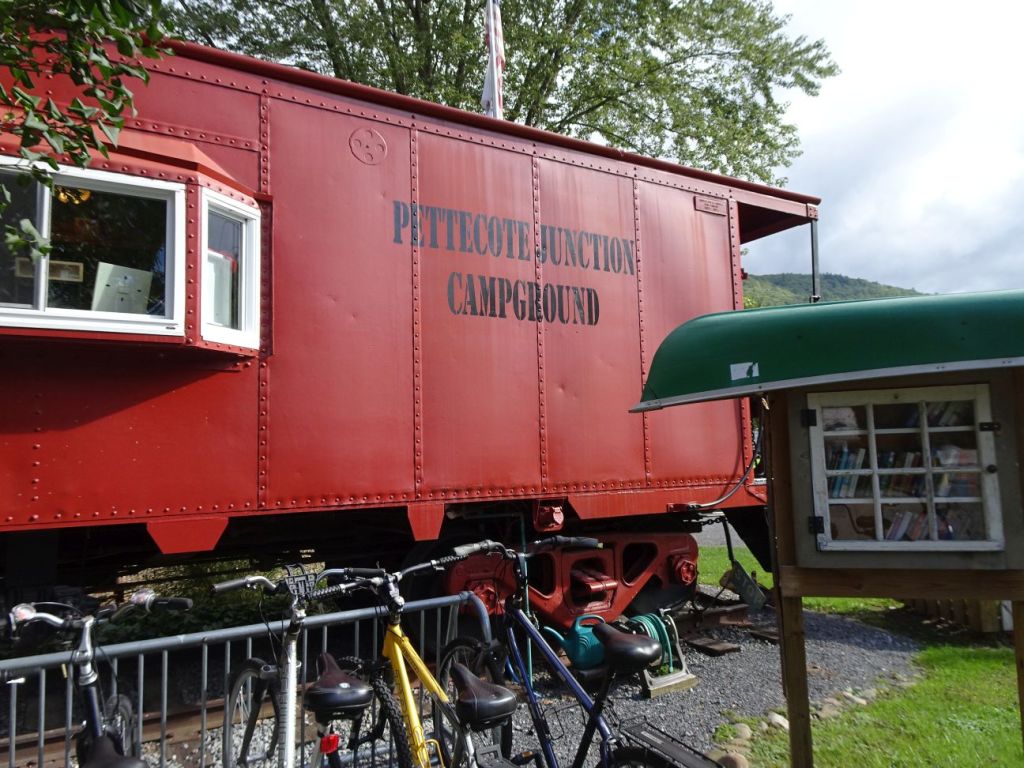
From rails to trails
As we pedal along rail trails, we are left to our imagination about the passengers who traversed these paths before us. They likely had similar views of the rushing rivers below us. Limestone bluffs tower over some bike paths we have visited.

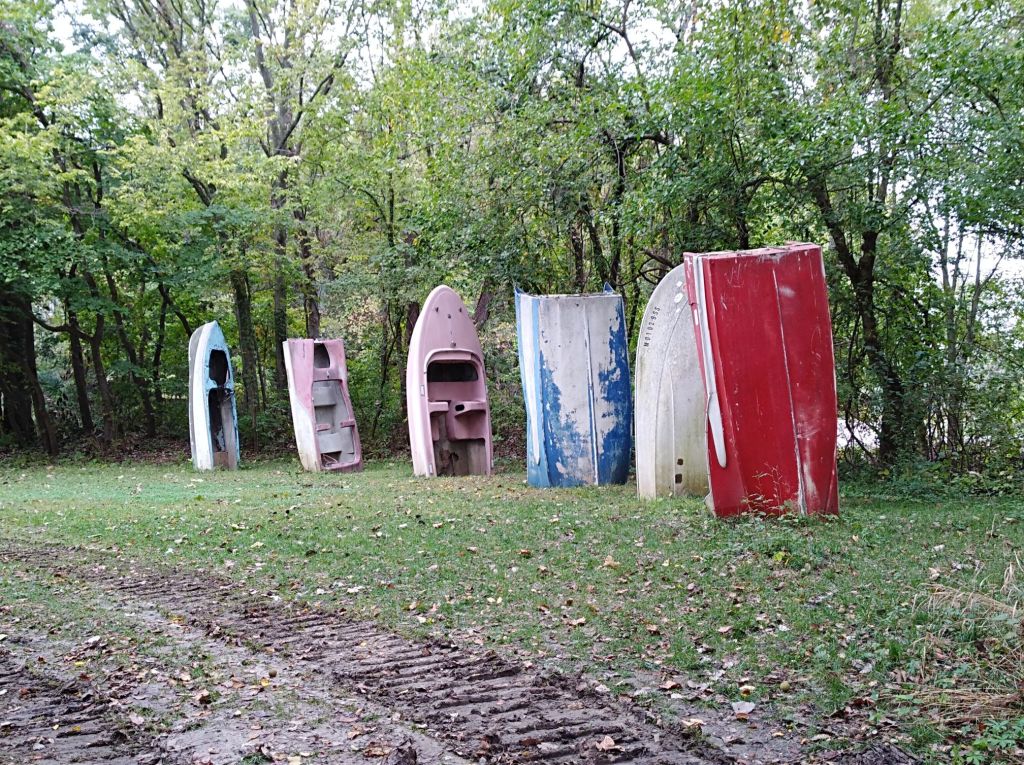
The Guest River Rail Trail in Virginia and the Katy Trail in Missouri rail trail feature bluffs that would have been standing watch years before as trains passed by.

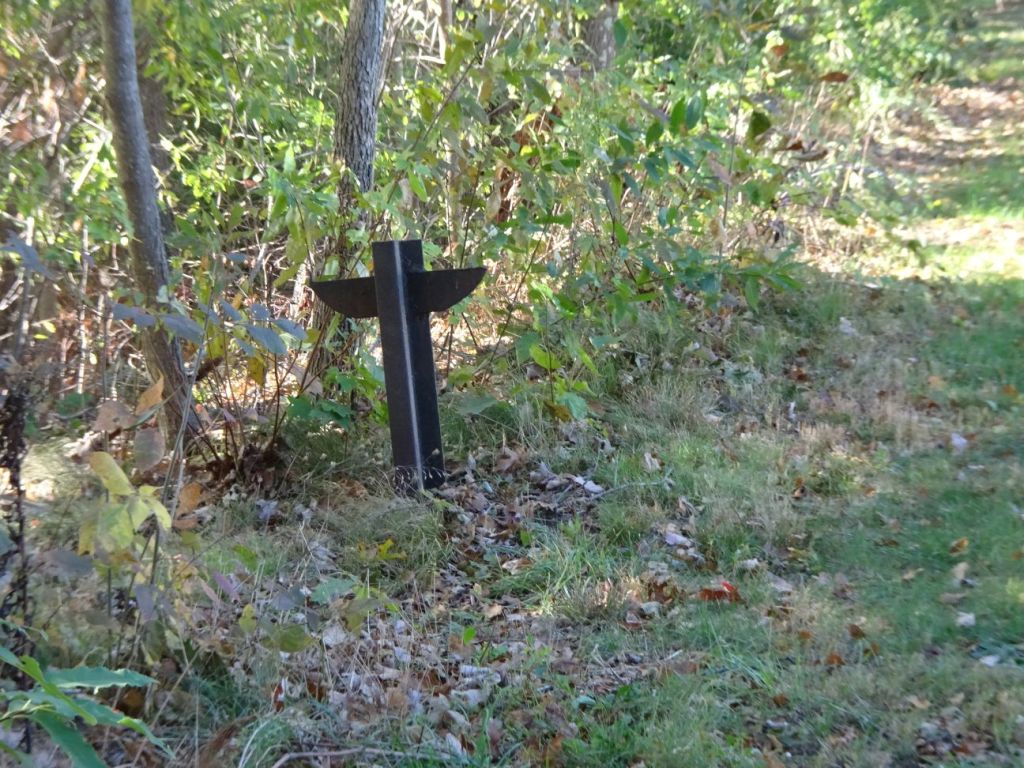
We have seen abandoned steel rails and other railroad equipment on the many rail trails we have visited. Additional train-related signage and infrastructure has been left in place, or installed after a rail trail has been developed. Granite posts along the way featuring a “W,” meaning “whistle” are a common sight. They notified the engineer that a grade crossing ( a road crossing at the same elevation as the train) was imminent.
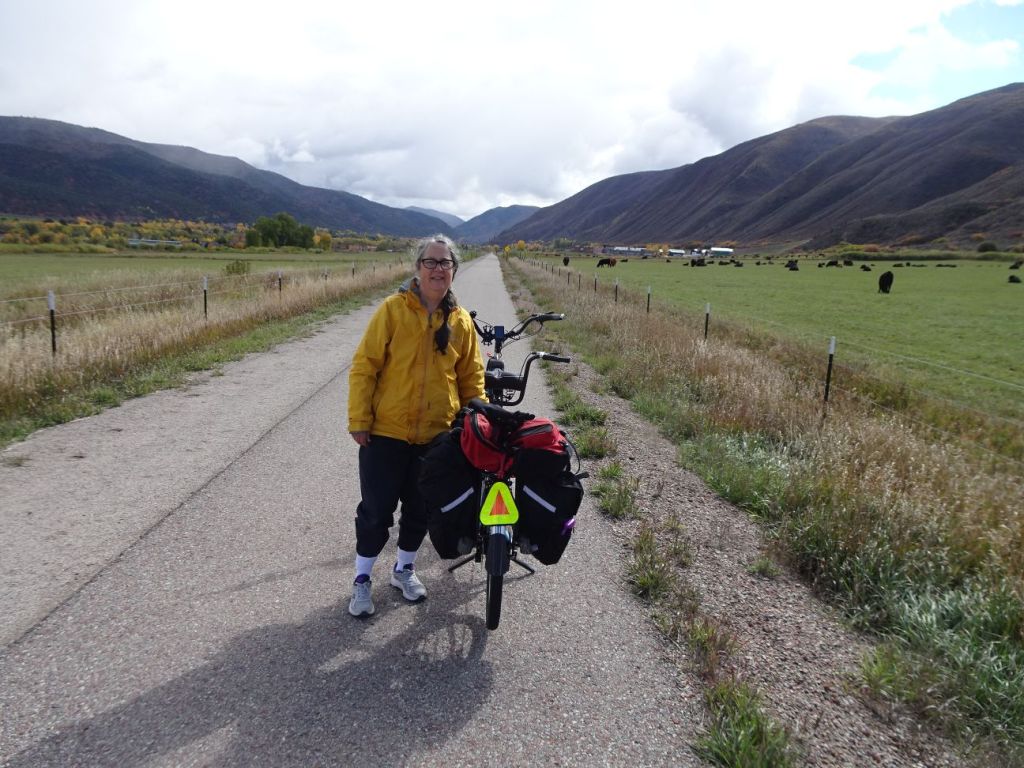
We spent an entire day pedaling along the historic Denver and Rio Grande footprint, now a 42-mile rail trail called the Rio Grande Trail. It runs from Glenwood Springs, Colorado to Aspen. Wide valleys are surrounded by mountains on either side of the trail. Bridges carried us over the foaming Roaring Fork River. We rode on dry ground in mid-October, and nearby mountain peaks showed a dusting of snow.
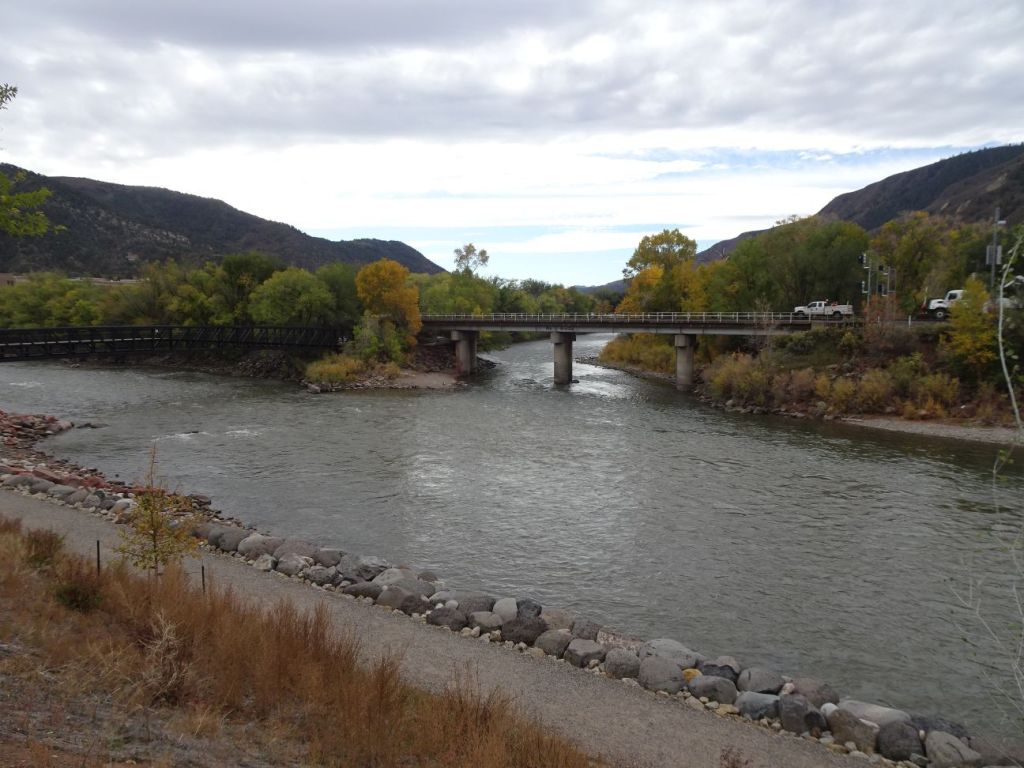
On a less strenuous day we walked through a city park close to where we were staying in Glenwood Springs . After crossing a bridge over the Colorado River we strolled along the rail trail next to the Roaring Fork River, part of the Rio Grande Trail we had visited the day before. The town is the site of the confluence of the Roaring Fork and Colorado Rivers. Glenwood Springs had been recently founded when E. J. passed through on the trip through this area that she wrote about. Originally called Defiance, the name of the town was changed shortly thereafter to reflect the natural hot springs that remains an attraction to this day.
Trains and canals
Trains were often built adjacent to canal tow paths. Rivers offer natural pathways through hilly terrain. The same principles apply when engineers choose routes, whether for canals or trains, and now for highways. Canals were built before trains came on the scene. Trains often put canal companies out of business. Highways have made many train routes obsolete, which brings us full circle to the development of abandoned tracks repurposed for recreation.

When traveling, did E.J. see from her train nearby canal boats towing goods downstream? The Chesapeake & Ohio Canal, (C&O) from Maryland to Washington D.C., remained in operation from 1828 to the early 20th century. In 1885 E.J. traveled from New York City to Washington, D.C. to perform in “A Celebrated Case” at the Herzog Theater the week of President Grover Cleveland’s inauguration. Perhaps she caught views of the boats in the canal and the family members that steered them. Other people guided the animals towing the cargo. While this was arduous work for those managing the boats, it must have been a common sight for onlookers and for travelers, an interesting diversion on their way somewhere else.
We have visited the C&O Canal a number of times. Our bike has carried us on the canal tow path, and we have walked along the banks of the Potomac. Portions of the tow path, now a rail trail, are within sight of train tracks. We have seen (and heard!) trains pass by as we camped alongside the Potomac at McCoy’s Ferry National Park campground in McCoy’s Ferry, Maryland.

The Lehigh Canal Company and the Lehigh Valley Railroad Company each built transportation infrastructure along the same route. It seems likely that E .J. traveled by train through this area along the Lehigh River. If so, she would have been able to see the river. The canal tow path was just below where the train tracks were built.

The canal and its locks were, for the most part, washed away by a series of major floods. Today, railroad tracks tower above the restored tow path. Retaining walls installed along the railroad right of way remain along the trail. Telegraph poles still strung with wire stand next to the tracks. These are reminders of days gone by including telegraph equipment that gave way for telephones and other more sophisticated forms of communication.
Some bridges built for trains are still standing. The tow path has become a twenty-four mile bike path alongside the Lehigh River. We have ridden our tandem bicycle the entire length of the rail trail through Lehigh Gorge State Park.
E.J. traveled to Wilkes-Barre twice; in 1890 to play Lady Dunscombe in the production of the play “Jim the Penman,” and in December 1892 to play Mrs. Horace Bellingham, principal of the Bellingham Select Seminary, in the play “Joseph.” Wilkes-Barre, where the following letter was written, is just a few miles north of the Lehigh Gorge State Park.
(I was delighted to learn of the reference to Mrs. Bellingham, having lived in the town of Bellingham, Massachusetts for most of my life.)
WYOMING VALLEY HOTEL, H.J. Dennin, Prop’r,Wilkes-Barre, Pa., Decr 30th 1892
My dear Son, Daughter, and Grandson, [Edward Phillips Nickinson, our grandfather]
I wish you a merry glad New Years with health, prosperity & all good things to enjoy it. We arrived here at 5 PM yesterday, a ride of 12 hours, having left Johnstown at 5AM . We had a long wait at Harrisburg and took dinner there. Altogether this has been the roughest, most disagreeable week we have encountered. Theatre cold & dirty. Hotels not much better but this one is comfortable. We leave here for Scranton at 2:25 PM. Said to be only a 50 minutes ride. Love and Kisses to each and all from your loving Mother
E.J. embraced travel and shrugged off hardships. Delays were common. Heat and dust were a reality of any form of travel. She clearly enjoyed the companionship of most her fellow performers. She also expressed great interest in the passing scenery and looked forward to new experiences.
Letter was in an envelope postmarked “Nampa, Idaho” Jun 21, 1890. Friday AM June 20th
My dear Son
We are on the Northwestern road going up to Portland. [Oregon] Slept under blankets last night and plaid shawl around my shoulders. We are going through Alkali plains and sage brush (as on the U[nion] Pacific Road).
Think we shall soon reach some Mountain scenery. I am told it rains five days a week in Seattle. We are due in Portland tomorrow 6:40 AM. Stay there until Sunday 11 AM when we start to Tacoma, to arrive there in the Evening.
No one complains very much of fatigue. We have had no excessive heat or dust to contend with, and that accounts for our good feelings. Just commenced raining. First time I have seen rain so far West, but then I am a month earlier than heretofore. It will keep the dust down. I enclose a bit of Mountain flower for Neppie [her daughter-in-law] with my love and Kisses. Love and Kisses to you both from your loving Mother
A note was added to the letter in a different hand, probably written by Betty Nickinson Chitty, one of E.J.’s great-granddaughters.
Enclosed in the envelope is a small spray of pressed flowers which could be sage — still has a purplish cast to it.
If E.J.’s letters are any indication (and we feel they are), she took great pride in her work and embraced the rigors and novelty of travel. However, sentiments she expressed in her letters also convey her ambivalence. She sounds torn between spending time with her children and grandchildren, and enjoying the work and fun. We have learned which performers she was close to, which were clearly undependable, and those who were fun to be around. She also revealed some of colleagues’ flaws, including drinking, drug use, and various scandalous behavior.
She was also appreciative of the gainful employment the work provided by pursuing her performing career. Clearly she loved both her children and the stage. As a performer, she knew that travel was required to maintain employment, as it still does to this day. Can we have it all? Perhaps, but not usually at the same time.
Once E.J. arrived at each venue where she was scheduled to perform, her professional duties took precedence. She managed to fit in social diversions, made time to visit with friends, and had occasional adventures, but the play was the thing. We’ll learn more from her about life as a performer in future posts.
Marjorie

Marjorie Turner Hollman is a writer who loves the outdoors, and is the author of Easy Walks in Massachusetts, 2nd edition, More Easy Walks in Massachusetts, 2nd edition, Easy Walks and Paddles in the Ten Mile River Watershed, Easy Walks South of Boston and Finding Easy Walks Wherever You Are. Her memoir, the backstory of Easy Walks, is My Liturgy of Easy Walks: Reclaiming hope in a world turned upside down.
For a comprehensive collection of letters and information related to EJ Phillips: here.
 Marjorie Turner Hollman