

Marjorie Turner Hollman is a writer who loves the outdoors. Link to all Marjorie’s books.
LISTEN HERE
“Hit ‘em harder, Mom,” I was said to have coached my mother. We were visiting my mother’s great Aunt Em, known to all, including her grandchildren, simply as Aunt Em. She was also known as “The aunt who lived in her barn.”
She had invited us to gather some quail from her dovecote for our dinner. My mother agreed but worried that my sensitive spirit might be disturbed by seeing small birds killed for our meal. Little did she know….
In later years when we stopped to see Aunt Em, she took us down to her dock at the bayou’s edge and invited us to have some crabs. She hauled up the trap she had baited, and soon we had a bunch of crabs to take home for our supper.
She also invited us into her barn, which was not only where she lived, but where she made young and old welcome. I discovered twin sets of tin cans dangling by strings on a wall of her barn. My feet fit comfortably onto the top of a pair of the tin cans outfitted with long loops of twine. I placed my feet, one on each can, clutched the strings and clomped up and down the concrete floor of the barn. The cans made child-sized stilts for my cousin and me and we tromped with great enthusiasm (and noise!) around the barn yard. Another cousin remembers the gum Aunt Em had at the ready for children who visited. She was always prepared for company.
Years after my infamous visit to help kill some birds for dinner, I imagined sitting on Aunt Em’s dock with her. She and I talked about that long ago visit when my mother and I came to catch us some squab.
“Your mother worried that you’d be upset when we went out to the dovecote to catch those little birds for your family’s supper. I sent her in with a baseball bat to knock some of them down for you to take home.
“She thought you were so tender-hearted, but turns out she didn’t know you so well after all. Hah! Instead of feeling bad for those baby birds, what did you do? “Hit ‘em harder, Mommy!” you cheered her on, over and over, as your mother struggled to catch enough birds for a meal. We laughed, watching you gesturing with your arms, trying to show your mother just how she should swing the bat. Your enthusiasm about the whole enterprise showed the sturdy stuff you were made of. Your mother swung wildly, one swipe with the bat after the next. She was great at swimming, but other sports, like baseball? Not so much.
“She got more and more frustrated and embarrassed as we watched her. That sure wasn’t what I intended. In the end, I had to step in and help, and you all got your squab for dinner. That was a good thing.
“Your family also took home a story that has been retold to this day. I’d say that worked out pretty well for everyone except for those little birds. But after all, that’s farm life, and it’s what I raised them for.
“You know, I wasn’t that surprised that you got into the spirit of the occasion. You remind me a little of myself when I was a girl. I guess we both have ways of surprising people, and lots of folks underestimate us. But we’ve shown them…every time. Never, ever underestimate a woman in our family. Do not forget that.”
Children adored Aunt Em. Grownups looked forward to spending time with her. She was never too busy to stop and sit down for a visit, which happened with great frequency.
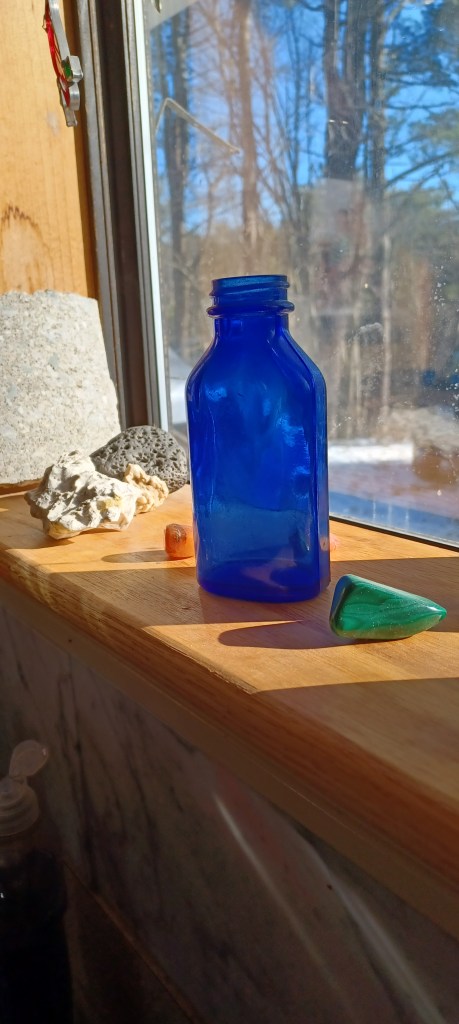
Aunt Em was a woman way ahead of her time. While other genteel southern women were having iced tea and meeting friends for social gatherings, Aunt Em was tending her farm animals and was always ready to make time for a visit. She also collected cobalt blue bottles and lined her paths and garden beds with them. I have one on my windowsill. She was known for being down to earth, practical and unswayed by societal conventions.
For most of her adult life she refused to wear dresses, which to her were so impractical. Her standard attire was sturdy pants. It made her work on her small farm easier, but also reflected her determination to be unconventional. Before she died she stated that she was to be buried in her pants and button down shirt, with her bolo tie around her neck. Her family made sure that her wishes were respected.
Growing up, my mother lived within walking distance of Aunt Em’s farm next to Bayou Texar (pronounced “Ta-har”) in Pensacola, Florida. It’s too late to ask Mom about her visits with Aunt Em. I expect she got a good bit of loving from this strong-minded woman who cared deeply for those around her.
I wish I’d thought to ask Mom why Aunt Em lived in her barn. It never occurred to me to question it. It might have seemed odd if someone else had made that choice, but for Aunt Em, it was the most natural thing in the world. It was only years later that I learned she had not always lived in that barn. In fact, she had a perfectly lovely home right next to the barn, which she walked away from in the grief-filled days after her youngest daughter, so dearly beloved, died at age twelve.
We all mourn loss in different ways. Some of us, perhaps because of our own discomfort with grief, urge others to “get over it.” Others of us avoid mentioning another’s loss for fear of making things worse. And yet some, like my Aunt Em, take our grief and allow it to manifest itself in our day to day lives. Not out of a wish to draw attention or pity, but as a way of life. A life lived with loss and grace.
Aunt Em’s response to this tragedy transformed her barn into a place others sought out, drawn to her like bees to honey. The manifestation of her grief brought sweetness and joy to those she encountered. Was she a sweet woman? Not that I ever heard about. And yet, her love of life, her passion, and her sense of humor radiated from her in everything she did.
I still think of her to this day and wonder. Wonder how she felt, wonder where her strength came from, and wonder at the choices she made. What I do not wonder about, however, is that she made a difference in the lives of others. I know she did for me.
Marjorie

Marjorie Turner Hollman is a writer who loves the outdoors, and is the author of Easy Walks in Massachusetts, 2nd edition, More Easy Walks in Massachusetts, 2nd edition, Easy Walks and Paddles in the Ten Mile River Watershed, Easy Walks South of Boston and Finding Easy Walks Wherever You Are. Her memoir, the backstory of Easy Walks, is My Liturgy of Easy Walks: Reclaiming hope in a world turned upside down.
 Marjorie Turner Hollman